
Document fraud stories: real cases that show why detection can't wait
Table of Contents
[ show ]- Loading table of contents...


Key takeaways
- These fake document fraud cases from 2024–2026 range from a $500,000 forged letter of credit at Boston's Croft School to a $650 million Ponzi scheme built on fake Netflix and HBO contracts.
- Roughly half of identity scams now involve AI tools, and stolen tax forms sell for as little as $20 on dark web marketplaces.
- In nearly every case, the fraud was caught in context: by bank tellers, detectives, and AI systems that flagged metadata or semantic anomalies, not visual ones.
In early 2026, researchers identified what scholars now believe is the oldest known written accusation of document fraud: theologian Nicole Oresme's 14th-century declaration that the Shroud of Turin was a forgery, passed off as authentic by dishonest clergymen (Popular Mechanics, March 2026). The Shroud's likely illegitimacy was documented for 600 years before modern science confirmed it.
Document fraud isn't new. It's just gotten faster, cheaper, and a lot harder to spot.
The document fraud examples below come from the past 18 months: a Missouri woman who almost auctioned off Graceland with forged loan papers, a school founder accused of fabricating a $500,000 letter of credit, a $650 million Ponzi scheme built on fake entertainment contracts, and a dark web marketplace where complete tax forms sell for $20. Each was unraveled by someone, sometimes a bank teller, sometimes a federal investigator, who knew exactly what to look for.
Fraud fighters know the threat in theory. The point here is to make it concrete. We’ve also pulled in practitioner voices from our podcast, Good Question, including a Las Vegas detective who has investigated more document fraud cases than most fraud teams will see in a career.
For broader trend data, Inscribe’s 2026 Document Fraud Report analyzes trends across millions of documents and 90 fraud leaders.
Someone Tried to Sell Graceland with Forged Loan Documents
In May 2024, Lisa Jeanine Findley nearly auctioned off Elvis Presley's Graceland.
The Missouri woman created a fictional company called Naussany Investments, fabricated loan documents claiming Lisa Marie Presley had borrowed $3.8 million against Graceland, forged a notary's signature, and published a fraudulent foreclosure notice in a Memphis newspaper announcing the auction. She posed as three different people and demanded $2.85 million from the Presley estate to walk away.
A judge halted the sale one day before it was scheduled. In September 2025, Findley was sentenced to 57 months in federal prison for what the judge called "a highly sophisticated scheme to defraud" (Action News 5, September 2025).
What this means for fraud teams: Fabricated loan documents and forged notary signatures aren't exotic edge cases. They show up in lending queues every day. What made this case unusual was the target. The underlying technique was classic forgery, the kind that surfaces routinely in a document fraud detection workflow.
A $650M Ponzi Scheme Built on Fake Entertainment Contracts
Zachary Horwitz was an aspiring actor from Indiana who built a Ponzi scheme reportedly worth more than $650 million on a foundation of forged paperwork.
Operating under the screen name Zach Avery, he fabricated licensing agreements claiming Netflix and HBO were partnering with his film company, 1inMM Capital, to distribute movies abroad. He used the fake contracts, some carrying forged signatures and later backed by spoofed @netflix.com and @hbo.com emails, to attract wealthy investors. While the fiction held together, he bankrolled a lifestyle of luxury cars, courtside seats, and a $5.7 million home.
He was sentenced to 20 years in federal prison and ordered to pay $230 million in restitution (Rolling Stone, February 2022). Prime Video chronicled the rise and fall in Hollywood Hustler: Glitz, Glam, Scam, released in October 2025.
What this means for fraud teams: The document type changes; the manipulation pattern doesn't. A convincing-looking agreement with the right logos and formatting can move millions before anyone thinks to verify it.
A Forged $500K Bank Document Brings Down a School
On March 6, 2026, a man representing a Boston landlord walked into Leader Bank to convert a $500,000 letter of credit into cash to close a real estate deal for The Croft School's planned new campus. He was met by police instead. Bank officials had no record of the document and flagged it immediately.
The letter of credit, which Croft School founder Scott Given allegedly forged to skip a cash security deposit on a $12.5 million lease, was the first thread in a much larger unraveling. Within days, the school's board confirmed the document was fabricated and revealed Given had kept two sets of books for years, hiding roughly $13 million in unsecured debt (WPRI Target 12, March 2026).
What this means for fraud teams: A single forged financial document submitted to a bank triggered the collapse of a much deeper fraud. The bank employee who caught it is exactly the kind of detection layer that gets bypassed at scale without automated verification. That one catch can justify a detection system.is

When a Court Document Becomes the Evidence of Fraud
In March 2026, a letter purportedly written by FTX founder Sam Bankman-Fried and submitted as part of his retrial bid came under scrutiny. Not for what it said, but for where it came from.
Investigators found the letter had been sent via FedEx from Palo Alto or Menlo Park, not from the federal prison in San Pedro where Bankman-Fried is incarcerated. The signature was computer-generated. The prison type listed in the letter was wrong. Federal prosecutors stated the discrepancies raised "reasonable doubt as to whether the letter actually originated with Bankman-Fried" (Bitget / Cointurk, March 2026)..
What this means for fraud teams: Document fraud doesn't stop at loan applications. Suspicious documents surface in court filings, regulatory submissions, and any context where a piece of paper is used to claim a right. The detection signals are consistent: metadata anomalies, mismatched provenance, and signatures that don't hold up under scrutiny.
AI-Generated Document Fraud and the New Face of Identity Verification
A March 2026 CBS News investigation showed how easily consumer-grade apps can generate deepfake videos, realistic identity documents, and cloned websites within minutes. Experts estimated that roughly half of identity scams now involve AI tools. In a live demo, a fabricated passport was built from social-media data alone. One expert said the result could be "used almost to get approved 100% of the time" (CBS News, March 2026).
This is a theme Inscribe has been tracking closely. On a recent episode of Good Question on AI-generated documents, Senior Research Scientist Martina Pugliese walked through three fakes generated by Inscribe's internal team: a synthetic Apple Store receipt, a polished invoice, and a bank statement with altered names. Each was flagged by Inscribe's AI-generated content detectors.
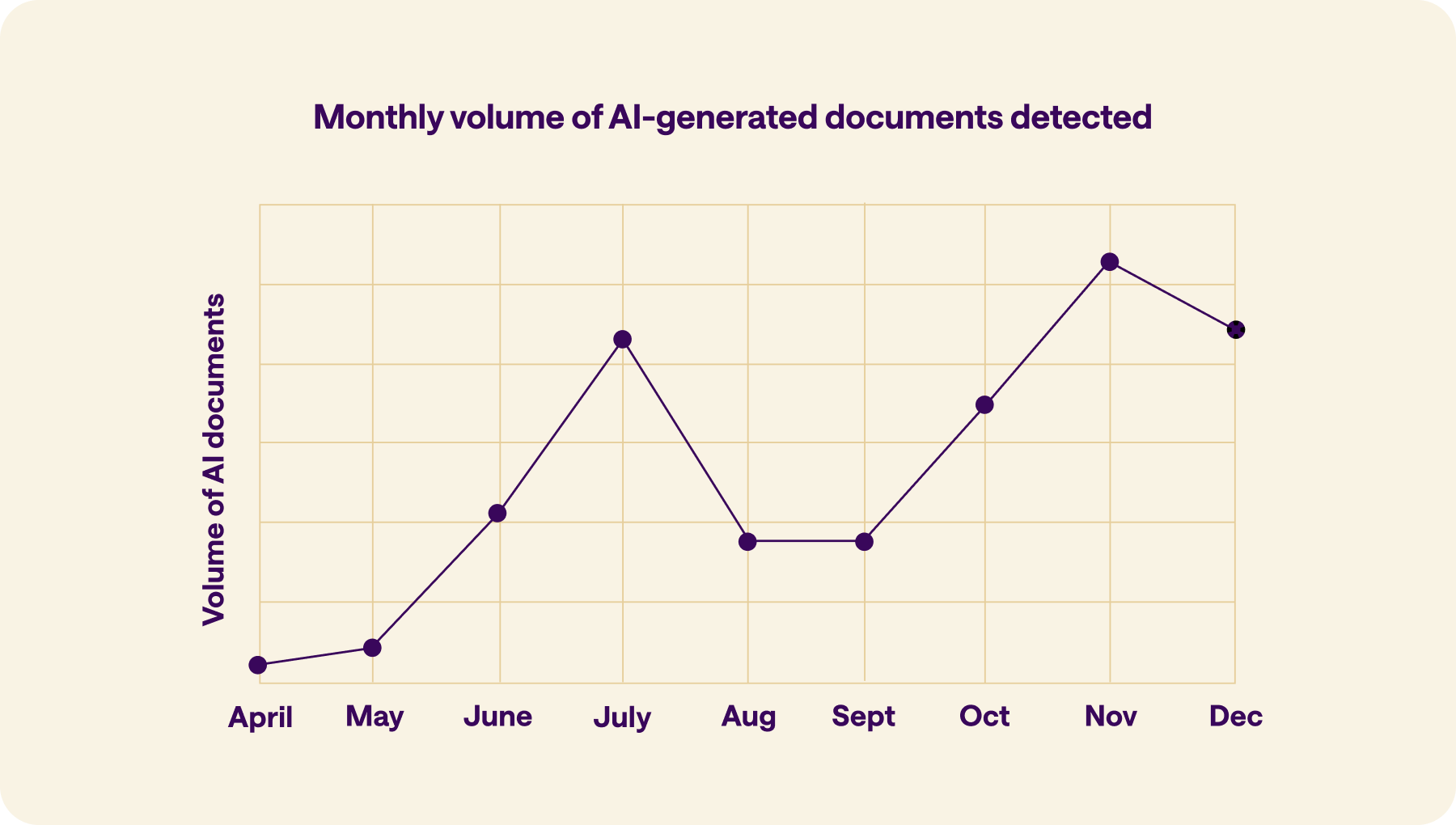
Detective Marc Evans, a Las Vegas fraud investigator, made the same point. After testing Google's Gemini Nano Banana image model, he told us he was "shocked at how easy it is to change a document on that. All you do is put a simple one-sentence prompt into it. This is a whole new level of fraud."
What this means for fraud teams: The barrier to creating a convincing fake document is lower than it has ever been. This is the present operating environment, not a future threat.
Your Tax Forms Are for Sale, for $20
Some of the most common financial document fraud examples don't start with a forger at all. They start with a buyer.
A Malwarebytes investigation into dark web marketplaces found complete stolen tax forms, including W-2s and 1040s with full personal information, selling in bulk for as little as $20 per identity. One listing offered 100 forms for $2,000. Forgery services like "Fakelab" produce custom W-2s or realistic bank statements on demand for $20 to $40. The research also found compromised CPA firm access being auctioned to criminals looking for a centralized vault of client data. (Malwarebytes Labs, March 2026).

What this means for fraud teams: Financial documents don't get forged in isolation. They're part of a supply chain. By the time a fake W-2 or fake bank statement lands in your lending queue, it may have been purchased, customized, and submitted by someone with under $50 invested.
A Trained Bank Employee, a Forged Business Filing, and a Felony
In Jefferson County, West Virginia, Dana Marie Phillips was convicted in November 2025 of forging a Secretary of State business registration document and passing it as authentic to a local bank. A trained bank employee caught the scheme. Phillips was sentenced to two to ten years in prison on one felony count (The Real WV, November 2025).
What this means for fraud teams: Business document fraud isn't limited to financial statements. Company registration documents, corporate filings, and authorization letters are forged too, and frequently surface in business loan origination and KYB workflows.
A Nonprofit Director Charged with $135K in Forgery
In April 2026, the Royal Newfoundland Constabulary charged Valerie Barter, former executive director of the nonprofit Violence Prevention Avalon East, with defrauding the organization of more than $135,000 between 2021 and 2023. The charges include fraud over $5,000, forgery, uttering forged documents, and breach of trust (CBC News, April 2026). The allegations have not been proven in court.
What this means for fraud teams: Internal fraud often runs longest because it's submitted by someone with legitimate access. The forged documents look right because the person submitting them knows what right looks like.
What Fraud Fighters Are Saying: From the Good Question Podcast
The forged documents in these real cases came from headlines. The patterns behind them come from the people who see this every day.
Detective Marc Evans, Las Vegas Police Department. On a recent episode of Good Question, Detective Evans (also known to many fraud fighters as Fraud Hero) walked us through years of document fraud investigations. He described catching a suspect mid-forgery, with the fake treasury check still up on his Photoshop screen. He also recounted a car dealership sting where an applicant forged signatures on bogus loan paperwork in front of undercover detectives. The clue that gave him away? A fake DMV temporary license printed with the name of a governor who had been out of office for ten years.
Evans was emphatic about why explainability matters. "If you can't explain how the document is not legitimate, you have no case," he told us. "If you have something that says 'this is why it's fraudulent,' it makes it so much easier, not just for law enforcement but for the courts."
Conor Burke, CTO and co-founder, Inscribe. On the Sam Altman AI fraud crisis episode, Conor noted Inscribe has seen a 200% increase in AI-generated fraud detections in recent months, many slipping past manual review before being caught downstream. "These AI-generated documents do leave behind artifacts."
The same episode covered John Dixon, former head of tax at EY, caught in 2024 forging six declarations of trust using law firm templates. What gave him away wasn't the formatting. It was the unusual language and timing. Even pre-AI fraud unravels at the seams of context.
Patrick Lord and Timothy O'Rear, Rapid Finance. On the Rapid Finance episode, the team described how their funnel pull-through has gone from below 50% in 2016 to 85 to 90% today, in part because of automated document checks at the top of the funnel. As Tim put it, the first thing he does on any application is open Inscribe to see what's been flagged. "Inscribe is very much baked into our workflow at a very deep level, both in sales and underwriting."
Document Fraud Cases at a Glance
The Common Thread
Document fraud is rarely caught in isolation. It's caught in context. The document fraud consequences in federal prison sentences, restitution orders, and collapsed institutions only happened because someone, somewhere, recognized the signal.
A bank teller who spotted a letter of credit they had no record of. A detective who recognized a governor's name from a decade ago. A research scientist who noticed math that didn't add up on a synthetic Apple Store receipt. The fraudster almost always leaves something behind. The question is whether the receiving system is built to find it.
That’s the kind of problem Inscribe is built around: helping fraud teams evaluate documents in context, surface explainable signals, and understand why a file should or shouldn’t be trusted. As Detective Evans put it: “It's not enough to just say this is a fraudulent document. Explain to me how you know it is.”
Keep Going
👉 Listen to Good Question for more document fraud cases and insights: inscribe.ai/resources/podcast
👉 Read the 2026 Document Fraud Report for data from millions of documents and 90 fraud leaders.
👉 See Inscribe's document fraud detection in action at the Demo Center.
FAQ

Document fraud is the submission of forged, altered, or fabricated documents to obtain money, credit, or legitimacy. It includes everything from forged bank statements and fake tax forms to AI-generated identity documents and fabricated business filings.
Recent examples include the Graceland forgery scheme (forged loan documents, $3.8M claim), Boston's Croft School ($500K forged letter of credit), the Hollywood Hustler Ponzi scheme ($650M built on fake Netflix and HBO licensing agreements), and dark web marketplaces selling stolen W-2s for as little as $20 per identity.
Most cases in this article were caught in context, not at the surface. Trained bank employees flagged unfamiliar instruments. Investigators noticed metadata anomalies, mismatched provenance, or signatures that didn't hold up. Increasingly, AI-powered detection tools flag forged documents real cases at the top of the funnel before they reach human review.
Document fraud consequences range from federal prison sentences (Lisa Jeanine Findley received 57 months; Zachary Horwitz received 20 years) and millions in restitution, to the collapse of the institutions that submitted or relied on the fake documents.
About the author
Brianna Valleskey is a B2B marketing leader and Head of Marketing at Inscribe, where she leads the company's full marketing function and go-to-market strategy. She oversees brand, product marketing, demand generation, ABM, content, SEO/AEO, events, partnerships, and marketing operations, with responsibility for marketing pipeline and SQO targets. A former journalist and longtime storyteller, Brianna specializes in translating complex AI, fraud, identity, and fintech topics into clear narratives for enterprise audiences. She is the creator and host of Good Question, Inscribe's podcast on AI and fraud risk, and leads Inscribe's annual State of Document Fraud report.
What will our AI Agents find in your documents?
Start your free trial to catch more fraud, faster.