Document Fraud Detection Software | Detect Forged Documents with AI
Document fraud is harder to spot and easier to scale. What used to be crude edits now includes subtle manipulation, reused templates, and entirely fabricated files designed to pass basic checks. For fraud teams reviewing volumes of financial statements, manual review alone is no longer reliable or accurate.
Table of Contents
[ show ]- Loading table of contents...


Document fraud detection software helps teams identify forgery, fabricated, and misleading documents before they move downstream. Instead of relying only on visual inspection or document verification, it evaluates how a document was created, modified, and submitted to surface risk signals that are difficult to spot manually.
Inscribe’s software is built for fraud and risk teams that need clarity in real time. It analyzes financial statements quickly, highlights meaningful fraud signals, and provides explanations that support decision confidence.
What is document fraud detection software?
This type of software uses artificial intelligence, machine learning, and forensic analysis to identify forged, fabricated, tampered, or misused documents, even when they appear legitimate. Its role is to assess authenticity and accuracy, not just validate format or extract signals.
Generative AI, deepfake tools, and synthetic identity fraud have made fake documents easier to produce at scale. Manual review and standard document verification alone can no longer keep pace.
Document risk screening evaluates structured and unstructured signals, including document content, file details, and submission context, suspicious activity. It surfaces inconsistencies, editing artifacts, reused templates, and other signals that indicate document risk.
Coverage typically includes various types of bank statements, pay stubs, invoices, tax documents (W-2s, 1099s), utility bills, business documents, business registration forms, identity documents, medical records, and insurance claims. The same checks can help differentiate genuine documents from fake documents. For bank statements specifically, Inscribe's fake bank statement detector applies this analysis to the single most commonly targeted document type.
How do document fraud detection software vendors compare?
Document fraud detection software vendors differ mainly in whether fraud detection is the primary product or a capability layered onto document automation. Inscribe sits in the first group, an AI-first fraud detection platform built for the documents that move money. Banks, credit unions, fintechs, and lenders use it to verify bank statements, pay stubs, tax forms, and business documents before those documents reach a credit decision.
The table below outlines how several vendors in this category describe their own focus, including where Inscribe fits.
The right fit depends less on vendor category than on four things a buyer can test directly:
- Explainability of individual fraud signals. Can the tool show which element of the document was manipulated and why it was flagged, or does it return a score with no evidence behind it?
- Auditable output. Will the output hold up in an exam, an internal audit, or a compliance review months after the decision was made?
- Financial services specialization versus general-purpose document tooling. Models trained on bank statements, pay stubs, tax forms, and business documents behave differently from models trained on documents in general.
- Scale of the document network behind the models. Detection that compares a submitted document against a large corpus of real documents catches template reuse and serial fraud that single-document analysis misses.
A team that evaluates against these four criteria will land on the right vendor for its document mix and workflow, whether or not that vendor is Inscribe.
How does Inscribe detect document fraud?
Inscribe detects document fraud by analyzing how a document was created, modified, and submitted, then surfacing the specific signals behind every flag.
Detection runs against a network of tens of millions of real financial documents, which is what makes template reuse and serial fraud visible across applications rather than only within a single file.
Customer results:
- Kinecta Federal Credit Union prevented $850,000 in fraud and reduced manual review time by 99%. "The return we've seen from Inscribe is tremendous. Even catching just one fraudulent loan has made a meaningful impact." Jorge Cortes, Vice President, Enterprise Risk Management
- BHG Financial cut document review from 15 minutes to under a minute, making reviews over 90% faster. Michael Coomer, Director, Fraud Management: "Inscribe was the inflection point for us. It transformed fraud detection from a manual, subjective process into a scalable, transparent system we can trust every time."
- Logix Federal Credit Union prevented over $3 million in fraud across eight months. "We started using Inscribe in late April last year. And in just eight months, we saw potential loan fraud savings of over $3 million and countless ID theft saves." Matt Overin, Manager, Fraud Risk Management
Document X-Ray: Make the invisible, visible
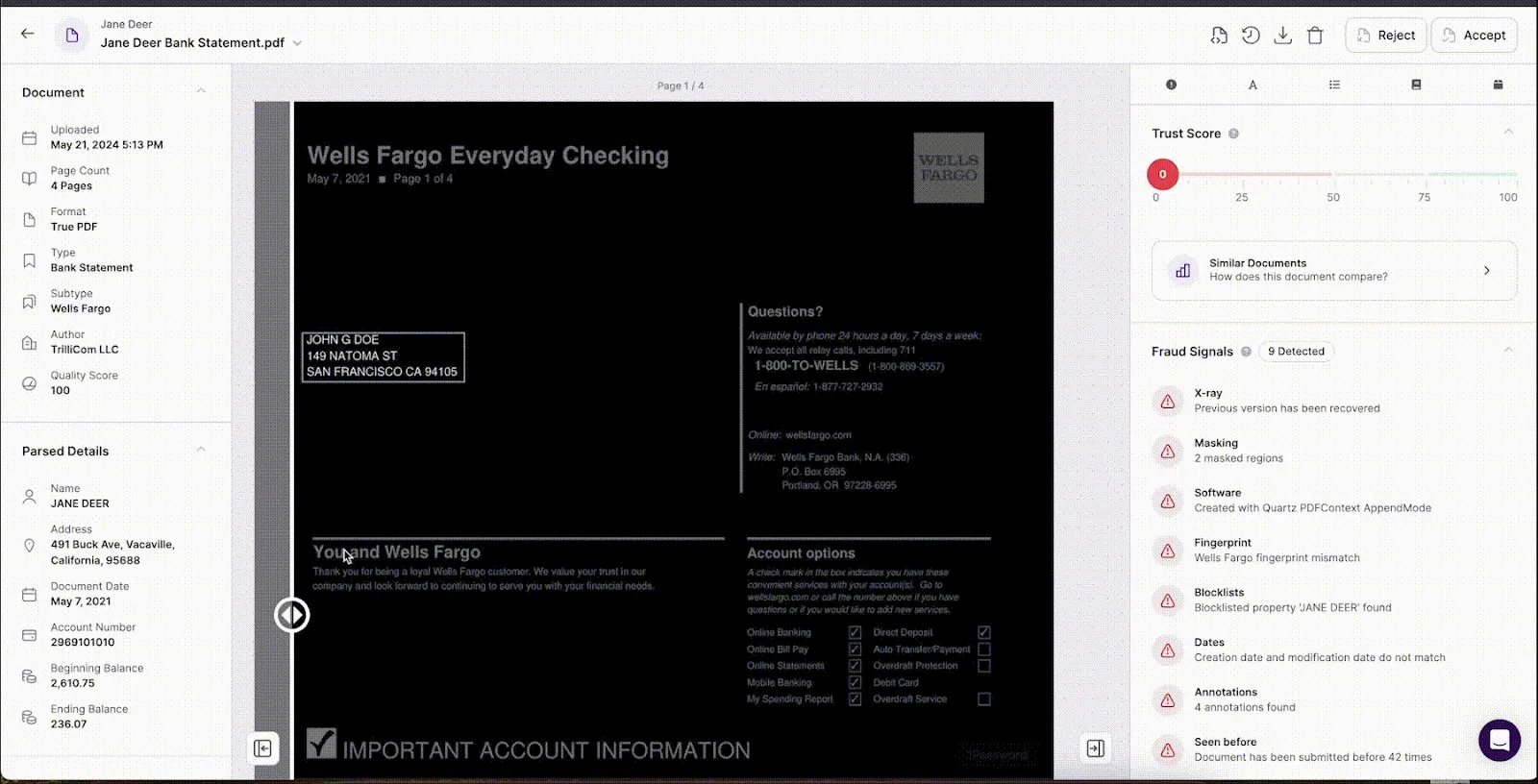
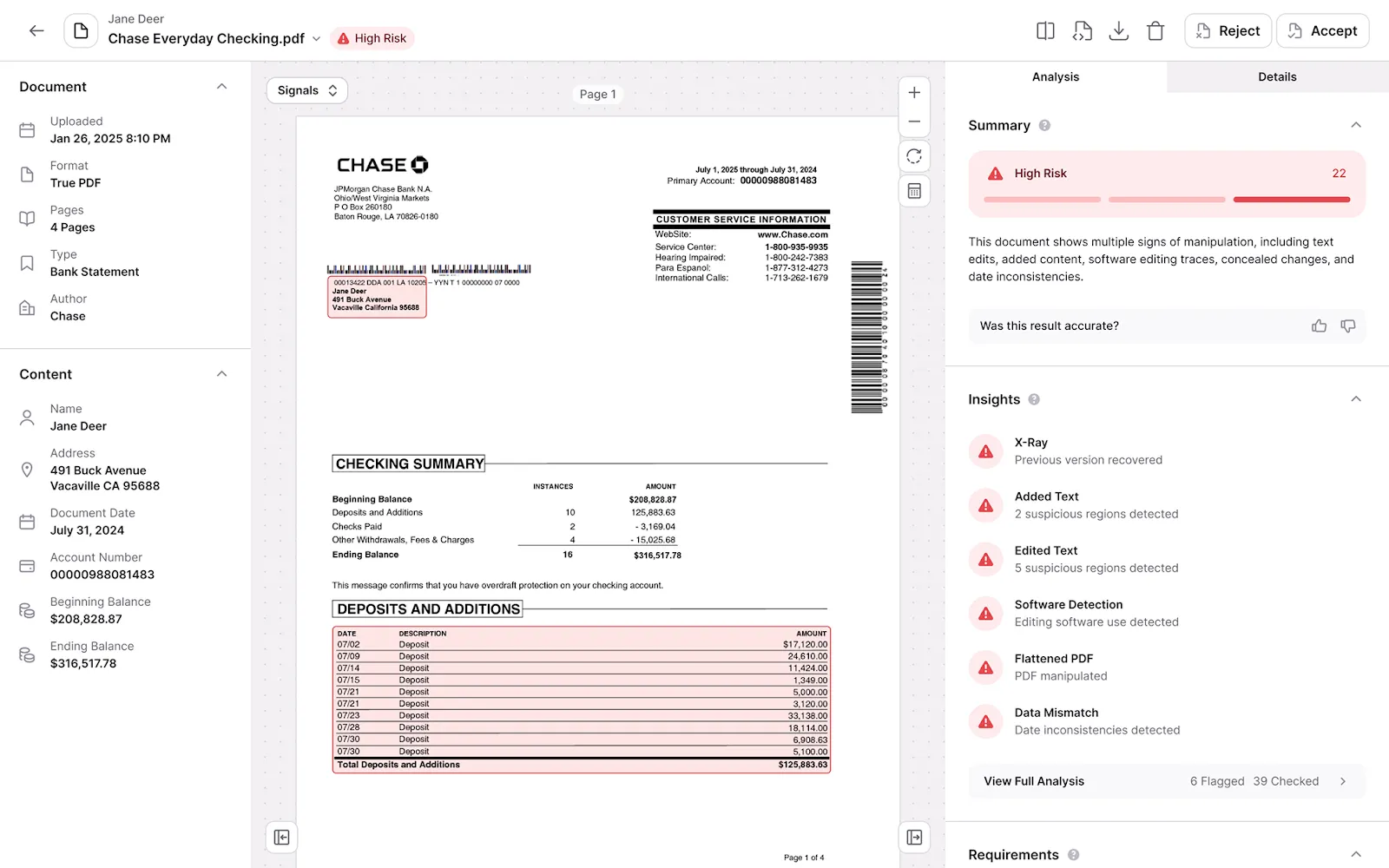
Document X-Ray surfaces revision history signals that are easy to miss during manual review. It shows what changed, what was originally there, and when changes occurred, helping organizations verify authenticity when values or text have been manipulated inside a digital file.
This is especially useful for scanned documents and PDFs that appear clean at a glance but contain edits designed to survive document processing and basic checks.
Network-based detection and metadata analysis
Inscribe’s risk screening software compares incoming documents against patterns seen across tens of millions of analyzed documents. This network context helps identify repeat patterns, template reuse and transactions, and structural similarities that are difficult to catch when reviewing a single file in isolation.
It also supports deeper forensic checks, including font analysis, layout and structural consistency, and the ability to review file history such as creation dates, editing software signatures, and edit history. Together, these signals help surface inconsistencies and assess whether a document matches known legitimate templates from specific institutions.
Natural language summaries & trust scoring
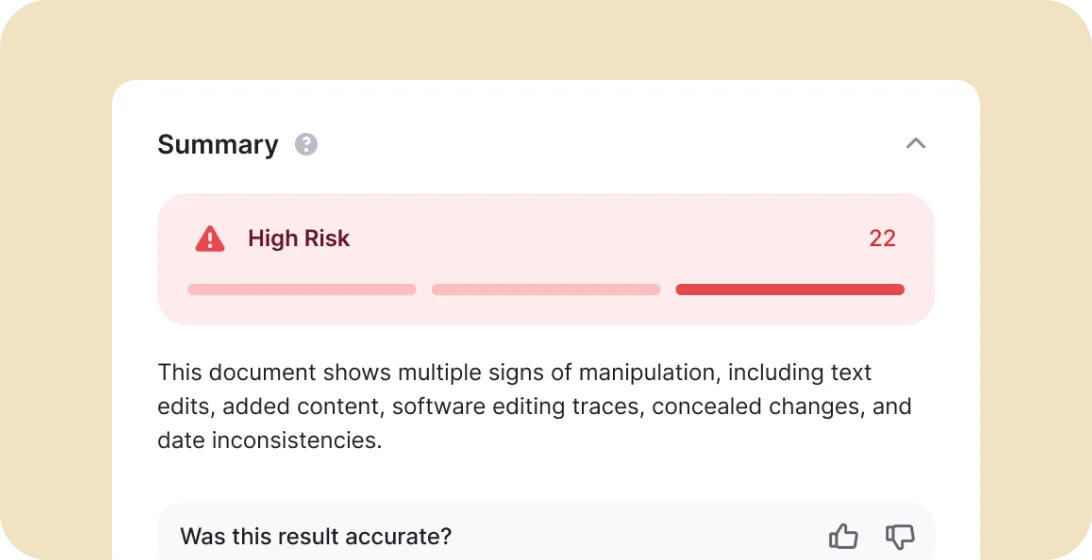
Inscribe assigns a Trust Score (0–100) and pairs it with plain-language summaries with contextual explanations that explain what was found and why it matters. This reduces analyst cognitive load by turning complex signals into clear reasoning that organizations can act on quickly.
Because the summaries document key signals in straightforward language, they also support audit-ready decisioning, stronger compliance posture, and more consistent escalation workflows, improving confidence across the organization.
Web-based research & cross-document corroboration
Inscribe accelerates external validation by checking names, addresses, and registration records against web sources and public data, reducing the need for manual research. For many organizations, this step is one of the biggest time drains in the process.
The platform also helps cross-check multiple documents within a submission set, so inconsistencies across types of documents or conflicting details are easier to spot. In practice, this can reduce review time from roughly 10 minutes per document to 72 seconds.
Advanced document parsing & LLM-powered text understanding
Inscribe uses custom ai models, including LLMs trained on financial statements, to interpret content in context rather than treating every field as a simple extraction problem. This makes it easier to surface manipulated numbers, misaligned formats, and cross-page contradictions that can hide inside otherwise plausible-looking documents.
This capability is especially important when multiple documents are submitted together and inconsistencies only become clear when information is compared across pages or files.
What are the three types of document fraud?
Document fraud is often grouped into three categories:
- Altered or forged documents are genuine documents that are modified after issuance, such as edited balances on a bank statement or changed dates on pay stubs.
- Fabricated documents are created from scratch using templates, generators, or AI tools, such as fake bank statements or falsified tax forms.
- Misused or counterfeit documents are legitimate documents used by the wrong person or copied to misrepresent origin, such as another person’s utility bill or ID.
How does document fraud actually show up?
The three-type model is useful, but it misses common real-world tactics that do not require editing a file. Inscribe uses a five-type framework that better reflects how risk appears in financial workflows.
1. Altered Documents
Legitimate files with changed values or fields (balances, income, dates). Subtle edits are designed to survive manual document review.
2. Fabricated Documents
Documents created from templates, generators, or AI. They may look consistent but do not match a legitimate source or history.
3. Misused or Borrowed Documents
Genuine documents submitted by the wrong person. Basic document verification may succeed because the document is real.
4. Manipulated Source Channels
Content looks legitimate, but the submission source has been altered (spoofed portals, mule accounts, manipulated file history).
5. Misleading Submissions
Real documents used deceptively through omission or context (outdated statements, missing pages, selective disclosure).
Types four and five are routinely missed because the document looks legitimate and passes basic verification checks. Risk does not always require editing a file. Effective review for fraud prevention looks beyond the surface and evaluates creation, submission, and context.
What problem does document fraud detection solve?
Stop fraud before it reaches your analysts
Document fraud creates financial crime risk. When forged or misleading documents pass initial review, the exposure is harder and more expensive to unwind, and it can lead to more fraud across portfolios over time.
Manual document review and static rules are slow, inconsistent, and error-prone at scale. As volume grows, manual review becomes a bottleneck that slows decisioning or forces shortcuts, increasing risk and reducing decision confidence.
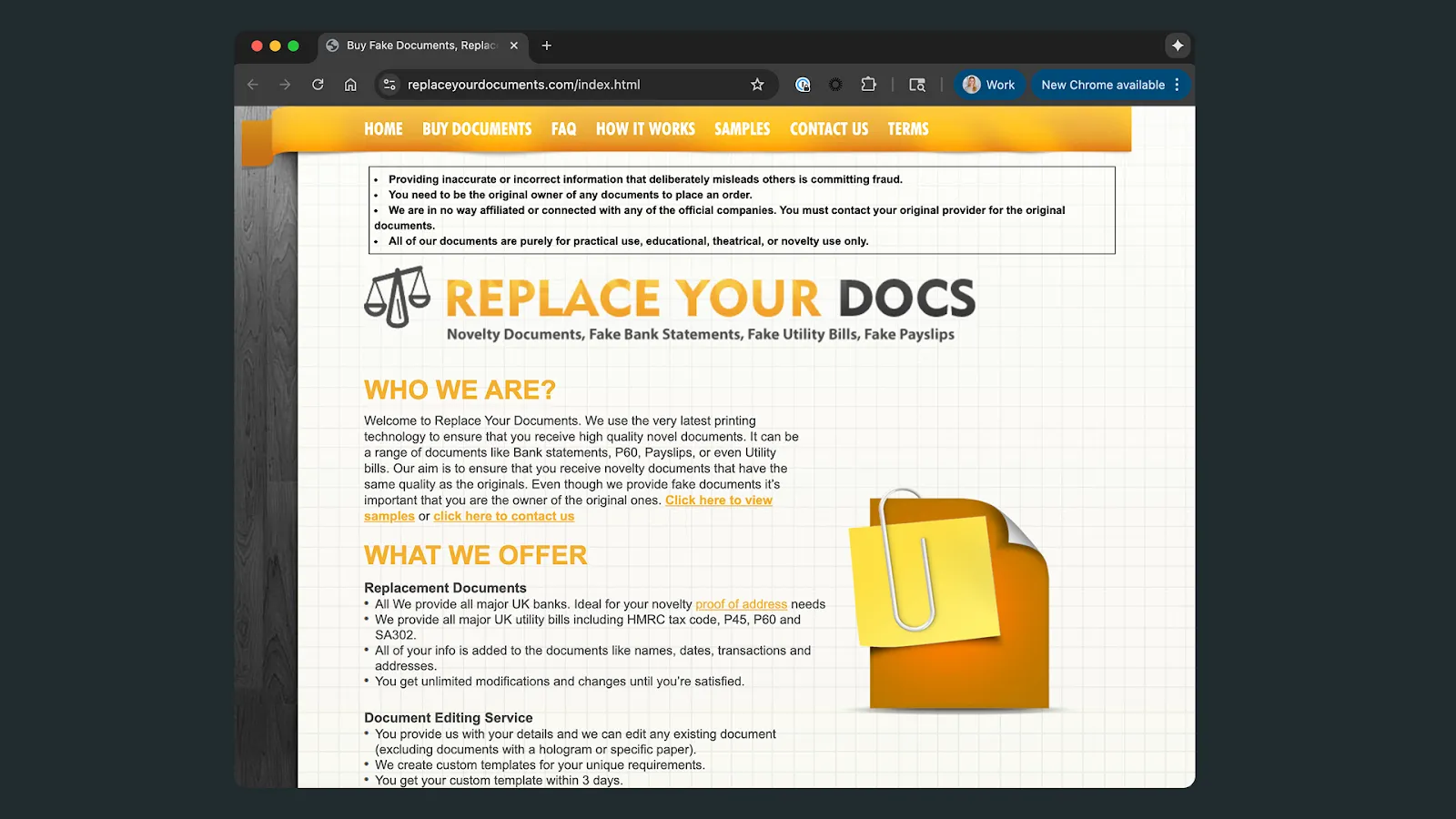
Fraud tactics now include PDF editing with known manipulation software, template reuse with copy-pasted personal information, font and formatting inconsistencies across pages, and synthetic document creation, including ai generated documents. Some cases still involve pre-digital document modification, such as altered scans or photographed paperwork. Others rely on fabricated suspicious transactions, inflated income figures, and anomalies like mismatched creation dates or unexpected software signatures.
Many tactics repeat. Templates are reused across applications and shared through online and dark web marketplaces, creating fraud patterns that are difficult to spot through manual review alone.
When teams cannot detect document fraud early, the impact extends beyond a single bad decision. Financial institutions face financial losses, higher loss reserves, regulatory scrutiny, reputational damage, and slower loan decisioning as controls tighten to compensate for missed risk. The 2026 Document Fraud Report outlines how document-based fraud continues to increase in volume and sophistication, raising the bar for early detection.
Inscribe’s platform helps teams identify risk during initial review by surfacing repeat patterns and signals that manual review often misses, so organizations can protect decisioning workflows and reduce overall fraud attempts.When teams cannot detect document fraud early, the impact extends beyond a single bad decision. Financial institutions face financial losses, higher loss reserves, regulatory scrutiny, reputational damage, and slower loan decisioning as controls tighten to compensate for missed risk.
Regulatory exposure compounds the problem. Financial institutions are required to maintain anti-money laundering and fraud controls under the Bank Secrecy Act. In November 2024, the Financial Crimes Enforcement Network (FinCEN) issued alert FIN-2024-Alert004 on fraud schemes involving deepfake media, which identified falsified and altered documents as a method criminals use to circumvent customer identification and due diligence controls, and reminded institutions of their reporting obligations under the BSA. Forged or fabricated documents that clear review create direct fraud losses. They can also surface as a compliance gap during an exam. The same exposure applies to manipulated financial statement fraud and to fabricated identity documents.
Inscribe's 2026 Document Fraud Report outlines how document-based fraud continues to increase in volume and sophistication, raising the bar for early detection.
What are the methods of fraud in documents?
Document risk is rarely a single trick. Bad actors combine techniques to produce documents that look legitimate and pass document based verification, especially when files are reviewed one at a time. The methods below map back to the five-type framework and explain why effective screening needs more than surface checks.
Digital alteration
This method edits an existing digital file to change specific values or details. Common approaches include PDF editing, pixel manipulation, and layer editing to adjust balances, income figures, names, or dates.
Identification relies on image analysis to surface anomalies and on the ability to review file history to determine how and when changes were made.
Maps to: Altered Documents
Template-based fabrication
Criminals use pre-made templates with swappable fields and insert real personal information into fabricated layouts. The output can look consistent enough to verify authenticity, even though no legitimate source exists.
Identification depends on spotting repeated structures and inconsistencies across files submitted over time.
Maps to: Fabricated Documents
Generative AI and deepfake document creation
Generative AI tools can produce synthetic documents from scratch, including realistic transaction signals, logos, and formatting that mimic legitimate institutions.
These files can be visually convincing, so screening often requires comparing documents to identify inconsistencies that only emerge across multiple submissions.
Maps to: Fabricated Documents
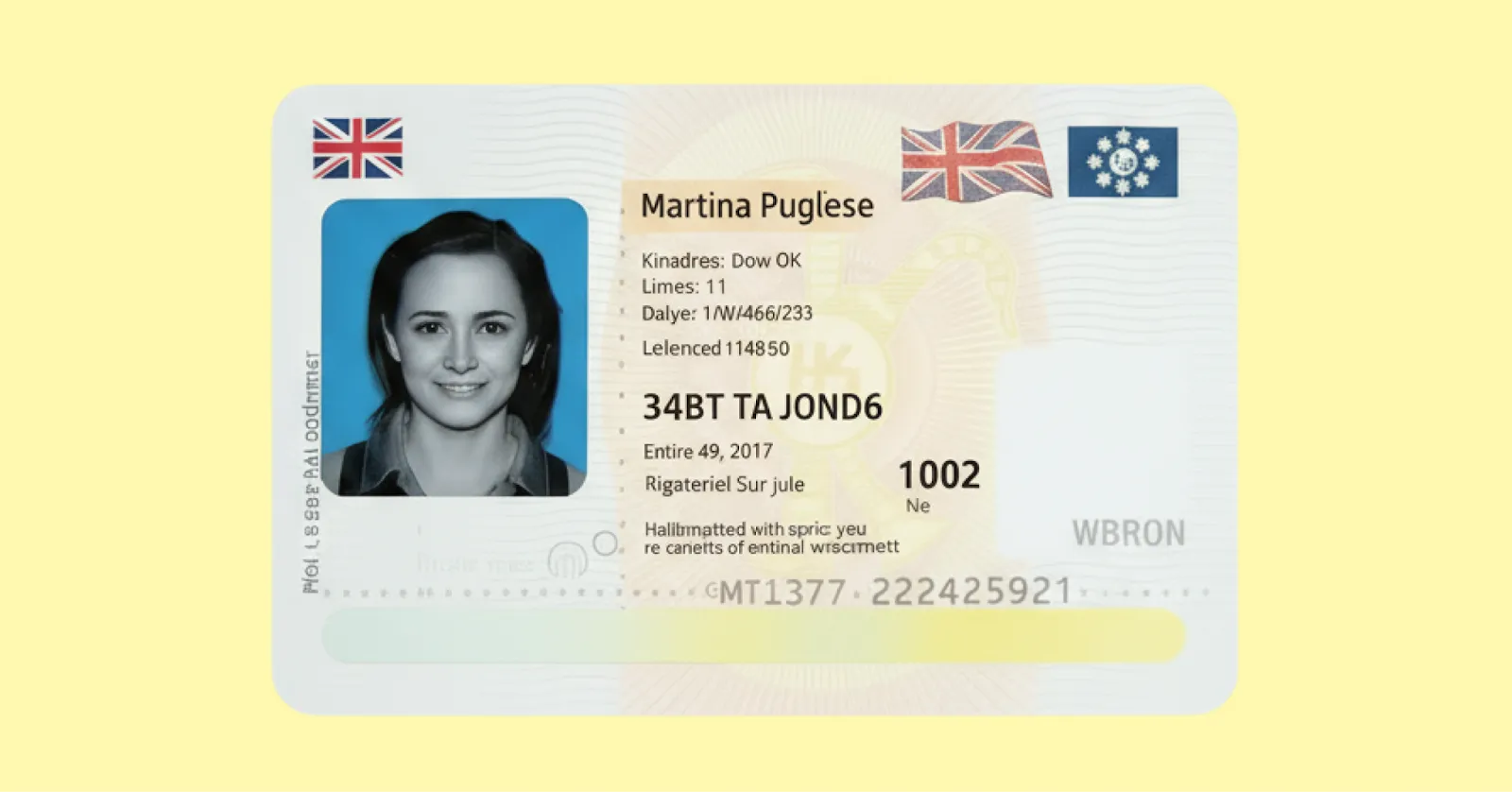
Metadata spoofing
File history spoofing alters a digital file’s underlying properties, such as creation dates, software identifiers, or edit history, to conceal manipulation. It is often used alongside alteration or fabrication.
The ability to review file history and compare it against expected patterns is critical to verify authenticity in these cases.
Maps to: Altered Documents, Manipulated Source Channels
Cross-document inconsistencies
Risk often shows up in the gaps between documents. When multiple documents are submitted together, mismatched fonts, logos, formatting styles, or conflicting information points can reveal misuse or selective disclosure.
Identification requires comparing documents as a set to surface inconsistencies that are easy to miss in isolated review.
Maps to: Misleading Submissions, Misused or Borrowed Documents
Social engineering paired with forged documents
Some submissions rely on scams as much as content. Criminals may pair forged or fabricated documents with plausible explanations, urgency cues, or supporting communications to reduce scrutiny.
Fraud prevention improves when organizations evaluate submission context alongside the document itself, rather than relying only on document based verification.
Maps to: Manipulated Source Channels, Misleading Submissions
Synthetic identity fraud
Synthetic identity fraud combines real and fake information into a fabricated profile supported by multiple documents. Individually, each document may appear valid. Together, the story breaks down.
Identifying this method requires looking beyond a single file to surface inconsistencies across documents and submissions over time.
Maps to: Fabricated Documents, Misused or Borrowed Documents
What evidence is needed to prove document fraud?
Proving document risk requires more than a gut check that “something looks off.” Investigations, audits, and legal proceedings require evidence that shows what changed, how it happened, and why a document should not be trusted. Evidence typically comes from five areas:
Metadata forensics
Creation timestamps, editing software identifiers, and revision history. The ability to review file history during document processing helps surface unexpected creation tools or edits.
Visual forensics
Font anomalies, pixel-level inconsistencies, and layer artifacts that indicate alteration or compositing.
Cross-document corroboration
Organizations cross reference document details across files (names, addresses, employer info, suspicious transactions) to surface contradictions or missing pages.
Network analysis and historical patterns
Historical signals and pattern reuse across submissions help identify whether a document or template has been seen before.
External validation
Web-based research used to verify documents against business registrations, addresses, and employer details, often pulling from public data and data sources.
Clear evidence also needs clear communication. A consistent severity score and audit-ready summaries help organizations act quickly without recreating analysis by hand and strengthen compliance workflows.
How do you detect document fraud?
AI-powered document analysis in 3 steps
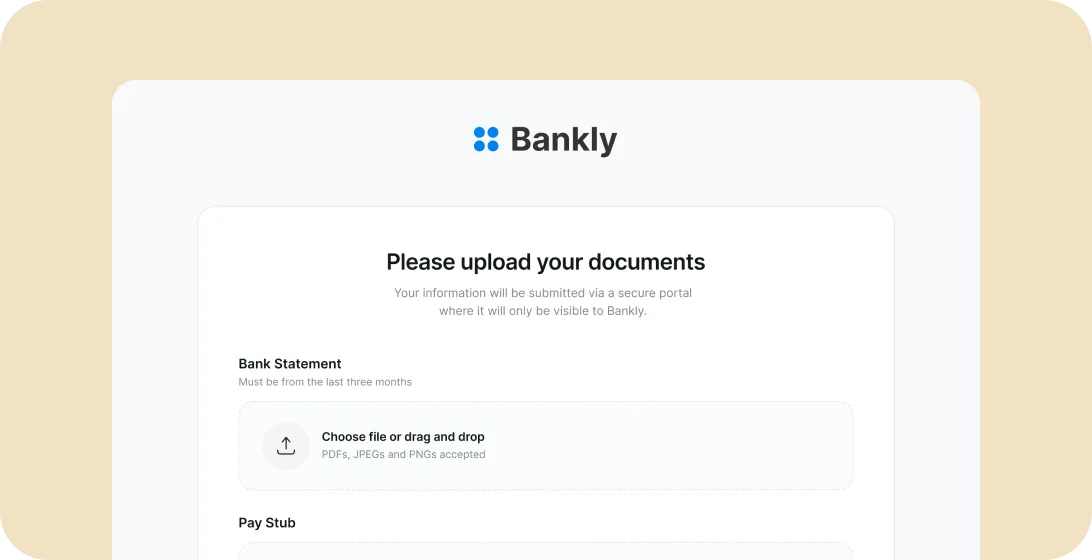
1) Submit a document
Upload documents directly into Inscribe’s risk screening software, or connect via API to your existing systems. This keeps document checks consistent across workflows, whether you are reviewing a single file or a full submission set of uploaded documents.
2) Run real-time analysis
Inscribe’s AI Fraud Analyst, ai models applies machine learning to spot document risk using multiple checks in parallel. This includes information extraction and optical character recognition, LLM-powered parsing, image forensics, file history checks, network-based comparisons, and cross-document analysis to identify anomalies that manual review often misses. The result is real-time screening that supports faster approvals without sacrificing accuracy.
3) Review insights instantly
Real-time results are returned in a structured, scannable format so organizations can act quickly. You receive a Trust Score (0–100), visual signals, severity levels, an event type, and natural language summaries with contextual explanations that show what was identified, what was flagged, and why it matters. This supports real-time results, higher accuracy and more consistent escalations, building confidence in decisions across risk and compliance workflows.
What is the best detection tool for document fraud?
The best document risk screening tool fits your document mix and workflow, and produces evidence your organization can defend.
Look for depth beyond document verification and standard document processing. The tool should surface forensic signals that point to manipulation, including editing artifacts, template reuse, cross-page inconsistencies, and file history indicators across the types of documents you rely on.
It should also hold up operationally. Results need to be real-time and consistent at scale, without creating a false-positive problem that shifts work from manual review to triage.
Explainability is often the deciding factor. Organizations need to understand why something was flagged, and risk and compliance teams need outputs that support audit review. Inscribe is built around visible signals, severity scoring, and plain-language summaries, which is central to the approach described on Why Inscribe. If you want to see the full flow end to end, the Demo Center walks through it.
Inscribe has been purpose-built for detecting fraud in documents since 2017, supporting teams across banks, credit unions, and fintechs. Examples are available in the customer stories.
Can AI detect fraudulent documents?
Yes. AI can identify fraudulent documents, and in many workflows it outperforms manual review at scale. It does not replace judgment. It helps organizations stay consistent by running the same document checks across every file, every time, supporting real-time analysis and stronger confidence in decisions.
Document risk screening platforms use machine learning models trained on large volumes of real-world documents to recognize manipulation patterns that humans often miss in a fast review. That includes signals that do not show up as obvious edits, such as subtle formatting drift, reused templates, file history irregularities, and inconsistencies that only emerge when multiple documents are compared.
In practice, AI-driven screening combines several methods:
LLM-powered text understanding to flag contradictions or values that do not align with context

Who is document fraud detection software for?
Built for risk teams, underwriters, and operations
Document risk screening is designed for organizations that rely on documents to make risk decisions and keep business processes moving.
It is commonly used by:
- Fraud analysts reviewing high volumes of documents and escalations
- Credit operations managers responsible for throughput, accuracy, and queue health
- Risk leaders setting policy, thresholds, and review strategy across portfolios
- Compliance officers focused on audit readiness and defensible decisions
- Loan underwriters verifying applicant documents before approval
- Property managers screening tenants and validating submitted documents
This type of software is also relevant across industries where documents drive decisions, including:
- Business lending, including BNPL and commercial finance
- Consumer lending, including personal loans and credit cards
- Fintech platforms supporting KYB/KYC verification
- Property management and tenant screening
- Traditional banks and credit unions
- Marketplaces and eCommerce
- Payment providers
- Insurance companies, including workflows tied to insurance claims
These workflows vary, but the underlying need is the same: helping organizations stop more fraud without slowing decisions or adding unnecessary friction. This can include document-driven risk tied to identity theft, employee risk, and invoice risk, where a single document can ripple through multiple downstream systems and transactions.
What’s the value of document fraud detection software?
The platform pays off when it reduces losses, shortens review cycles, and makes decisions easier to support. For most organizations, the value shows up in a few consistent ways, especially when you need protection at scale without sacrificing accuracy and with higher accuracy.
Millions in fraud losses prevented. With Inscribe, BCU uncovered sophisticated fraud rings and prevented $5.6 million in losses. You can read more about BCU’s approach and results here.
Faster document review. Automating first-pass analysis reduces manual effort and time spent on repetitive checks. Teams often move from 10–15 minutes per document to 72 seconds, while still capturing the signals needed for decision confidence and accuracy.
Fewer false positives and confidence in escalations. When signals are clearer and evidence is documented consistently, analysts spend less time chasing low-risk files and more time on cases that warrant attention.
Higher conversion through faster approvals. In many lending and onboarding flows, speed affects outcomes. Faster approvals can translate into fewer abandoned applications and more funded loans, without sacrificing accuracy.
Better compliance auditability. Explainable outputs, severity scoring, and audit trails make it easier to justify decisions in reviews, respond to audit questions, and keep documentation consistent across business processes.
Scalable and future-ready. Risk tactics change quickly. Tools that learn from new patterns and adapt to evolving risk reduce the need for constant rule rewrites and help organizations keep pace without expanding headcount.
Ready to detect document fraud at scale?
Don’t let document risk slow you down.
👉 Explore the Demo Center
👉 Get started with your free trial
👉 Learn more about AI fraud detection
Frequently Asked Questions

It’s software that uses artificial intelligence, machine learning, and forensic analysis to identify forgery, fabricated, or tampered documents. It automates review to spot manipulation that manual reviewers often miss, including file history anomalies, formatting inconsistencies, pixel-level alterations, and synthetic document creation.
Inscribe follows a simple flow: submit a document, run real-time analysis, and review results. The platform applies LLM-powered parsing, image forensics, file history checks, network-based comparison, and cross-document analysis, then returns a Trust Score (0–100), visual signals, severity, and plain-language summaries. For a walkthrough, visit the Demo Center.
It can identify altered documents, fabricated documents, and misused or borrowed documents, along with tactics that go beyond edited files. Inscribe also flags manipulated source channels and misleading submissions, including PDF editing, template-based fabrication, ai generated documents, file history spoofing, income manipulation, synthetic identity risk, and selective omission.
Document verification confirms a document is what it claims to be, such as matching expected formats, validating issuers, and supporting extraction accuracy. Screening goes further by assessing whether a document has been tampered with, fabricated, or forged, even if it passes basic verification checks. Inscribe supports both in a single platform.
Look for forensic depth (file history, pixel, and font analysis), coverage across bank statements, pay stubs, and invoices, speed and scalability, and clear explainability for analysts and auditors. Integration options matter, including API support and workflow compatibility. Network intelligence and adaptability to new risk patterns are also key differentiators.
Not entirely, but it changes what manual review is used for. AI handles repetitive, high-volume analysis so organizations can focus on higher-risk cases that require judgment. Inscribe can reduce review time by roughly 80% and surface signals that are difficult to spot manually, while human review remains important for escalations and edge cases.
Yes. Inscribe is API-first and can connect to loan origination systems, risk platforms, KYB/KYC workflows, and document management systems. Many organizations are able to go live in days rather than months. Documentation is available at docs.inscribe.ai.
Use document checks, then review file history and file details. For higher-risk workflows, real-time analysis shows what was flagged and supports confidence in decisions.
About the author
Ronan Burke is the co-founder and CEO of Inscribe, where he has spent nearly a decade studying how fraud evolves and what it takes to stop it. His work sits at the intersection of generative AI and financial crime: specifically, how AI-powered reasoning can outpace the fraud tactics that have already outrun rules-based detection. He writes and speaks regularly on document fraud, agentic AI, and what it means to build fraud defenses for a world where fakes are cheap, fast, and convincing.
Learn More
Dive deeper into our Solutions


What will our AI Agents find in your documents?
Start your free trial to catch more fraud, faster.