Loan Document Fraud Detection | Catch Fake Documents Before They Reach Underwriting
Loan underwriters are the last line of defense against document fraud and the first bottleneck in the lending pipeline. Manual document review takes 10–15 minutes per file, can’t detect sophisticated forgeries, and doesn’t scale with application volume. Meanwhile, fraudsters are using AI to create fake bank statements, fabricated pay stubs, and forged tax forms that pass manual checks entirely.
Table of Contents
[ show ]- Loading table of contents...


Inscribe is AI-powered loan document fraud detection software that fits directly into your underwriting workflow: verifying income, detecting fraudulent documents, and flagging forged files in approximately 72 seconds per document. Purpose-built for lending since 2017, trusted by leading banks, credit unions, and fintechs, and SOC 2 Type II + ISO 27001 certified. Logix FCU saved $3M+ in potential fraud losses. BCU prevented $5.6M.
Most underwriting tools assume the documents are real. Inscribe makes sure they are.
Below: how Inscribe works inside your underwriting pipeline, what it catches that other tools miss, and how to get started.
What problem does loan document fraud detection solve?
The Underwriting Bottleneck Is an Application Fraud Problem
Manual review doesn’t scale. As loan application volume grows, document review becomes the constraint that slows decisioning or forces teams to cut corners, increasing fraud risk and creating operational bottlenecks. Loan application fraud and identity theft tied to fraudulent documents remain the fastest-growing threats to the financial system, and manual processes can’t keep pace.
Extraction-only tools leave fraud uncovered. Tools like Ocrolus extract data accurately but can’t tell you whether the document is real. A perfectly extracted fake bank statement is still a fake bank statement. If your workflow trusts the numbers without verifying the source, you’re underwriting on potentially fraudulent data.
Fraud tactics are evolving faster than manual checks. AI-generated bank statements, professionally forged pay stubs, and template-based fabrication mean human reviewers consistently miss fraud that forensic detection catches. AI-generated and template-based document fraud is up 208%, per Inscribe’s 2026 Document Fraud Report.
The cost of missing it. A single approved fraudulent loan can cost tens of thousands. Across a lending portfolio, undetected document fraud represents millions in financial losses, legal consequences, and regulatory exposure.
How Inscribe’s Loan Document Fraud Detection Fits Your Workflow
Verify Document Authenticity in 4 Steps
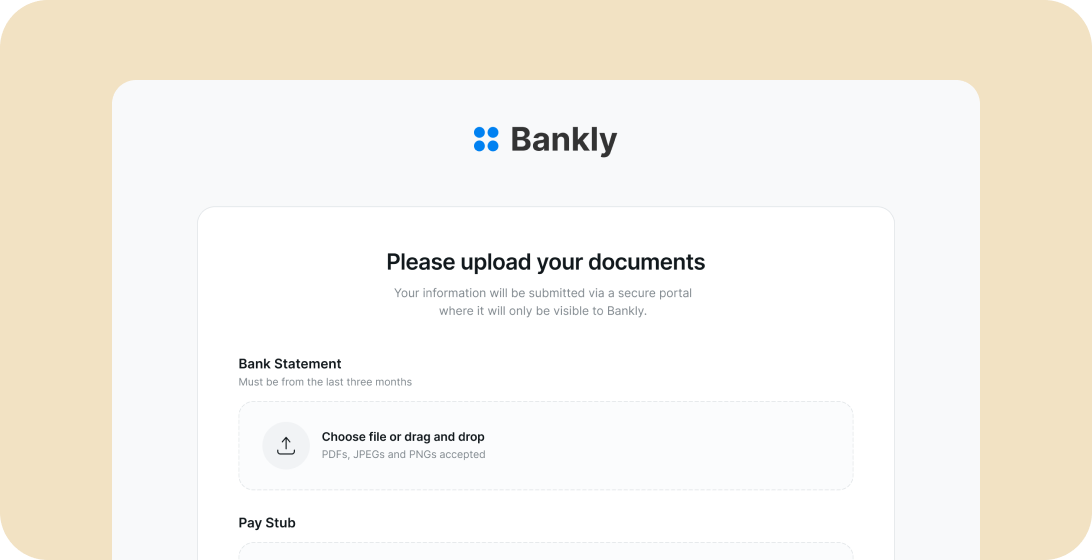
1. Submit documents. Upload bank statements, pay stubs, tax forms, and other financial documents via direct upload, API, or Secure Document Collection. Supports multi-page PDFs, scanned images, and files from thousands of financial institutions.
2. Extract and parse. Custom LLMs extract transactions, balances, income sources, employer details, and cash flow trends from complex document structures far beyond basic OCR. Integration details at docs.inscribe.ai.
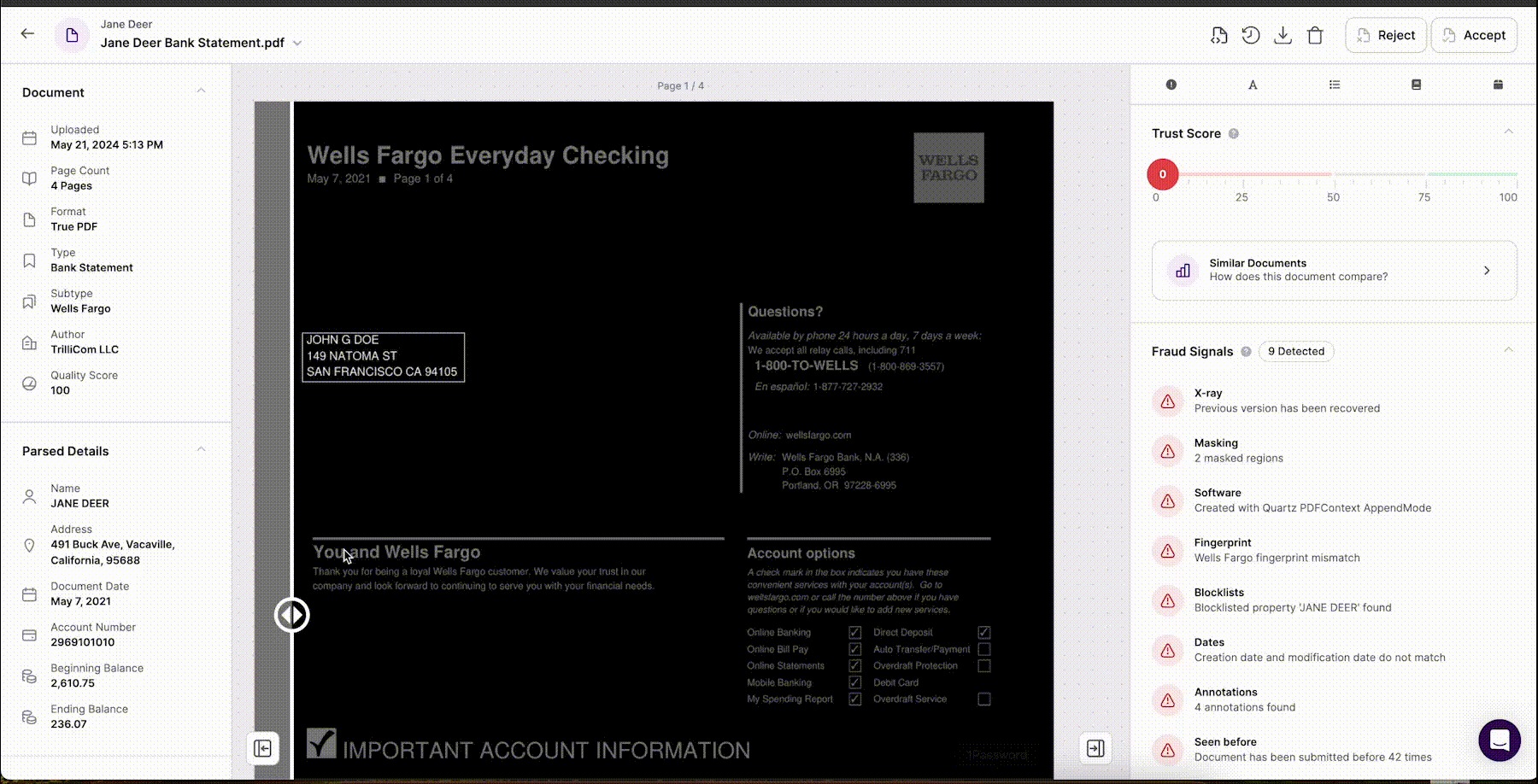
3. Detect fraud. This is where Inscribe differs from every other underwriting tool. Forensic-grade analysis runs on every incoming document: metadata inspection, font anomaly detection, pixel-level image analysis, revision history extraction via Document X-Ray, and network-based comparison against tens of millions of verified documents. These document checks surface red flags, identify suspicious documents, and flag AI-generated documents and subtle alterations that the human eye misses, giving your team clear signals for further investigation.
4. Review and decide. Every document receives a Trust Score (0–100) with visual fraud signals, severity levels, and plain-English summaries. Low-risk documents auto-approve. High-risk files route to human reviewers with evidence attached. Average processing: ~72 seconds vs. 10–15 minutes manual.
What Inscribe Catches That Other Document Fraud Detection Tools Miss
Forged Documents and Fake Financial Files in the Lending Pipeline
Fake bank statements. AI-generated, PDF-edited, and template-based fabrications are increasingly common in fraudulent loan applications. Inscribe detects font anomalies, metadata tampering, and revision history that prove manipulation even when the document looks flawless. Network intelligence compares incoming documents against patterns from tens of millions of analyzed documents. Learn more.
Fabricated pay stubs. Inflated income, altered employer details, inconsistent pay cadence. Cross-document corroboration catches discrepancies between pay stub amounts and bank statement deposit patterns surfacing fake income documents lenders miss in manual review.
Manipulated tax documents. Altered W-2s and 1099s with changed income or employment information. LLM-powered parsing detects numerical inconsistencies across pages and contradictions against other submitted financial documents.
AI-generated documents. Fully synthetic financial documents bypass traditional document checks. Inscribe’s network intelligence identifies structural patterns and metadata signatures that flag AI-generated documents and files built on fake information. It’s document fraud detection built for evolving threats.
Misrepresentation through omission. Borrowers submitting only favorable pages, hiding overdrafts or liabilities. Inscribe flags incomplete submissions and inconsistent page sequences that suggest selective disclosure.
Key Features: Loan Document Fraud Detection for Lenders
Document X-Ray (Know What Was Changed)
Surfaces a document’s full revision history including what was altered, original values, and which software was used. Every submission becomes an auditable evidence trail for identifying forged documents and subtle alterations. This is document verification powered by machine learning and forensic analysis, not format checks alone.
Trust Score and Natural Language Summaries
Every document receives a Risk Score (0–100) and Risk Rating with plain-English explanations of what was flagged and why. Reduces analyst cognitive load, enables informed decisions on potentially fraudulent applications, and creates audit-ready documentation.
Cross-Document Corroboration
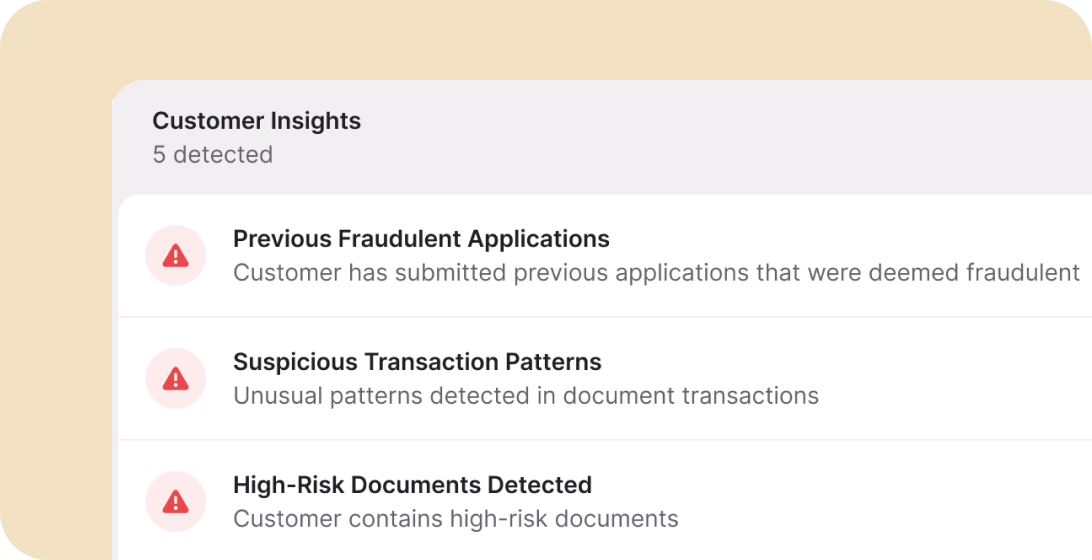
Cross-references all documents in a loan application such as bank statement deposits vs. pay stub amounts, tax income vs. stated income, applicant details across the set. Helps identify anomalies, flag suspicious patterns, and surface discrepancies that manual review misses.
Network Intelligence
Compares incoming documents against tens of millions of verified documents across thousands of financial institutions. Flags counterfeit documents, suspicious templates, fraudulent activities, and anomalies through pattern recognition no human reviewer could replicate across large volumes.
AI-Powered Data Extraction
Extracts transactions, balances, income sources, and cash flow trends from any format. Delivers structured data via API for direct integration with your loan origination system. See the bank statement analyzer.
Secure Document Collection
Built-in portal for requesting documents via secure links. Documents flow directly into verification, replacing email workflows and improving chain of custody. Explore the demo.
Who is loan document fraud detection for?
Loan underwriters, credit operations managers, fraud and risk leaders, heads of lending, and product/engineering teams building LOS integrations. Any team reviewing identity documents, financial statements, credit reports, or other sensitive information tied to loan applications.
Consumer lending
Personal loans, credit cards, auto loans. These are high volume, fraud-heavy, margin-sensitive.
Business lending
SBA, commercial finance, equipment financing. Any complex multi-document applications where synthetic identity fraud, income manipulation, and application fraud across multiple applications are primary vectors.
Mortgage
Income complexity, multi-borrower applications, strict compliance requirements.
Financial institutions that need audit-ready fraud detection
Financial institutions like banks, credit unions, and fintech lenders, that need explainable, audit-ready fraud detection with operational efficiency across the lending process.
Learn more for banks, credit unions, and lenders.
What’s the value of loan document fraud detection?
Millions in Financial Losses Prevented
Logix FCU saved $3M+. BCU prevented $5.6M. BHG Financial transformed fraud detection from a manual process into a scalable, transparent system. Early detection at the document level prevents chargebacks, write-offs, and the financial losses that follow funded fraudulent loan applications.
72-Second Processing vs. 10–15 Minutes Manual
Higher loan throughput without added headcount. Inscribe replaces the most resource-intensive part of document review so your team focuses on credit analysis and high-risk escalations.
Catch What Manual Review Misses
Metadata, font, pixel-level, and revision history checks run on every document, every time, surfacing fraudulent behavior and suspicious activities that multiple rounds of manual review would still miss.
Audit-Ready Compliance
Every decision is documented with Trust Scores, fraud signals, and evidence. SOC 2 Type II + ISO 27001. Defensible output for regulators and internal QA. Review Inscribe’s security posture.
Better Borrower Experience and Customer Trust
Faster decisions reduce drop-off rates. Genuine borrowers get faster answers with fraud prevention that protects customer trust without adding friction.
Ready to automate underwriting document review?
Most underwriting tools assume the documents are real. Inscribe makes sure they are.
👉 Explore the Demo Center
👉 Request a Live Demo
👉 Detect fake documents with Inscribe's Agentic Fraud Detection
Frequently Asked Questions About Loan Document Fraud Detection

Loan document fraud detection uses AI to identify fake, forged, and manipulated financial documents before they reach underwriting. Most underwriting tools assume the documents are real. Inscribe makes sure they are, running forensic analysis on every submitted document in ~72 seconds, verifying that the income and financial data your team underwrites on is accurate and not fabricated.
AI extracts data from financial documents at scale and detects whether those documents are authentic. Inscribe combines extraction with forensic fraud detection so underwriters get verified data, not just numbers from potentially fraudulent documents.
Yes. Inscribe analyzes metadata, fonts, revision history, and pixel-level details to detect forged, fabricated, and AI-generated bank statements, comparing incoming documents against tens of millions of verified files to flag deviations human reviewers miss. See the fake bank statement detector.
API-first with RESTful endpoints, webhook support, and structured outputs. Most customers go live in days. Documentation at docs.inscribe.ai.
Bank statements, pay stubs, W-2s, 1099s, tax returns, invoices, utility bills, identity documents, and business registration documents. Inscribe supports PDFs, scanned images, and digital files from thousands of financial institutions.
Extraction tools pull numbers but can’t verify document authenticity. Inscribe extracts data and detects fraud by adding Document X-Ray, network intelligence, and cross-document corroboration that extraction-only tools don’t offer. Most underwriting tools assume the documents are real. Inscribe makes sure they are. See the bank statement analyzer at inscribe.ai/solution-explorer/bank-statement-analyzer
SOC 2 Type II and ISO 27001 certified. Every decision logged with Trust Scores, evidence, and plain-English summaries. Review the Trust Center at https://trust.inscribe.ai/
Approximately 72 seconds per document, including extraction, fraud detection, and Trust Score generation. Compare to 10–15 minutes manual. Inscribe handles large volumes without operational bottlenecks.
About the author
Ronan Burke is the co-founder and CEO of Inscribe, where he has spent nearly a decade studying how fraud evolves and what it takes to stop it. His work sits at the intersection of generative AI and financial crime: specifically, how AI-powered reasoning can outpace the fraud tactics that have already outrun rules-based detection. He writes and speaks regularly on document fraud, agentic AI, and what it means to build fraud defenses for a world where fakes are cheap, fast, and convincing.
Learn More
Dive deeper into document processing

What will our AI Agents find in your documents?
Start your free trial to catch more fraud, faster.