
Bank Statement Analyzer | AI-Powered Bank Statement Analysis Software
A bank statement analyzer is software that uses AI to automatically extract, categorize, and analyze transaction data from bank statements. It replaces manual review with automated data extraction, fraud detection, and financial analysis so you can make faster, more accurate lending decisions.
Table of Contents
[ show ]- Loading table of contents...


In real underwriting processes, the best bank statement analysis tools do more than summarize spending. They turn statements into structured financial data you can use for decisioning, and they help you identify potential fraud before it reaches underwriting.
If you’re here because you want a personal finance tool (expense analysis, budgeting, categorization), you’ll find plenty of options in the market. But if you’re here because you need professional bank statement analysis for underwriting, fraud, and governance, most “statement analyzers” stop short. They extract data, but they don’t verify whether the statement itself is authentic.
Inscribe is a bank statement analyzer built for financial institutions. It analyzes bank statements at scale and runs forensic fraud detection to catch fake bank statements, forged transactions, fabricated balances, metadata tampering, and template-based manipulation that extraction-only tools can’t identify.
Inscribe has been purpose-built for document risk screening since 2017, trusted by banks, fintechs, and lenders, and built for audit-ready decisions. To see the full process end-to-end, explore the Demo Center.
What is a bank statement analyzer?
A bank statement analyzer (also written as bank statement analyser) is bank statement analysis software that converts statements into structured financial data you can use for decisioning. It extracts transactions, balances, account details, and patterns across time so you can understand cash flow, income consistency, and overall financial habits without manual entry. It unifies data from multiple bank accounts into a single financial profile, giving you a complete picture of an applicant’s finances.
Most tools in this category focus on data extraction and basic categorization. Inscribe goes further. For a fuller look at the category and how the tools compare, see our guide to bank statement analysis software.
What makes Inscribe different from other bank statement analyzers?
Many bank statement analyzers only extract data, or focus on converting the data first. Inscribe extracts data and detects fraud first, verifying that the statement is real before you trust the numbers.
That difference matters in high-stakes processes where “clean” extracted data can still come from a fabricated PDF.
Formats supported: PDF bank statements, scanned images, and digital files across thousands of institutions and statement layouts.
What problem does bank statement analysis software solve?
Manual statement review is slow, error-prone, and blind to fraud
Bank statement fraud is one of the most common forms of document fraud financial institutions face. When underwriting teams and fraud analysts review bank statements manually, the process breaks down fast:
- Processing time is too long. Reviewers may spend 10–15 minutes per statement when you factor in cross-checking and follow-up.
- Manual entry introduces errors. Transposition mistakes, missed transactions, and inconsistent categorization create risk.
- Review standards vary. Decisions depend on reviewer workload and experience, not a consistent process.
- It doesn’t scale. Volume creates backlog, and backlog creates shortcuts.
The money lost to fraudulent loans — and the time spent unwinding them — compounds quickly when manual processes fail to catch fraudulent transactions early.
Why do extraction-only/conversion-first tools leave fraud uncovered?
A tool can extract every transaction perfectly and still miss the real question: Is this document authentic? In today’s fraud environment, fake bank statements can look legitimate at a glance, especially when they’re created with professional templates and editing tools.
How are bank statement fraud tactics evolving?
Bank statement fraud tactics are evolving faster than manual review can track. According to our mid-year 2026 update on AI-generated document fraud, AI-generated document fraud grew roughly fourfold from June 2025 through May 2026, reaching new all-time highs.
Bank statements make up about one in four of all AI-generated flags, more than any other document type, with invoices and payslips close behind.
Inscribe's 2026 State of Document Fraud Report found the same pattern from the other direction: 85.6% of fraud leaders name bank statements as the most vulnerable document type. The formatting tells reviewers were trained to look for (inconsistent fonts, misaligned columns, odd spacing) are largely gone from AI-generated statements now.
What is the cost of not catching fake bank statements?
A single approved fraudulent loan can create losses that are expensive to unwind. At portfolio scale, undetected statement fraud becomes a material risk. If you want a current view into how document-based fraud is changing, the 2026 Document Fraud Report is a strong reference point.
What are the use cases for bank statement analysis?
Built for lending, fraud, and regulatory processes
Inscribe supports bank statement analysis across underwriting, fraud review, and regulatory processes where businesses need a comprehensive view of financial habits without relying on manual review. It’s built to streamline high-volume pipelines, reduce manual entry and errors, and surface fraud signals that extraction-only tools miss.
Consumer loan underwriting
Analyze 3–12 months of bank statements to verify income, evaluate cash flow patterns, and validate affordability. Inscribe helps flag inconsistencies like inflated deposits, unusual pay cadence, missing pages, or suspicious transaction patterns that indicate potential fraud, the same signals that matter for loan document fraud detection more broadly. Learn more for lenders.
Business lending and credit decisioning
Businesses processing commercial loan applications can use Inscribe to verify revenue, analyze expenses, and assess financial health across complex, multi-page bank statements, the same documents that get manipulated in financial statement fraud. It supports consistent decisioning across high-volume pipelines without adding headcount.
Fraud detection in bank statements
Go beyond extraction to detect forged, fabricated, and manipulated files, including AI-generated fakes, template fraud, and editing traces that show the document has been altered. To go deeper on bank statement fraud specifically, see Inscribe's fake bank statement detector. For the broader category, see document fraud detection software.
Property management and tenant screening
Verify applicant financial habits by analyzing bank statements for consistent income, sufficient balances across bank accounts, and authentic documents. Personal-finance-style categorization is useful here, but only if the file is real.
KYC/AML and enhanced due diligence
Use bank statements as part of regulatory processes requiring auditable verification outputs, evidence signals, and a defensible trail. For account opening, onboarding, and underwriting in banking environments, see Inscribe for banks.
Portfolio monitoring
Monitor existing borrowers for changes in financial health, unusual transaction activity, or early signals of distress across their bank accounts.
Who is it for?
Inscribe’s bank statement analyzer is built for teams that carry fraud exposure, regulatory posture, and throughput targets:
- Loan underwriters
- Fraud analysts
- Compliance officers (KYC/AML)
- Credit operations leaders
- Risk leaders setting thresholds and escalation strategy
- Product and engineering teams building onboarding, underwriting, and decisioning processes
Common industries include consumer lending, auto finance, business lending, banks and credit unions, fintech platforms, and property management.
How does Inscribe’s bank statement analyzer work?
From upload to insight in seconds
This is Inscribe’s process for automated bank statement analysis, built to reduce manual review without sacrificing fraud detection depth.
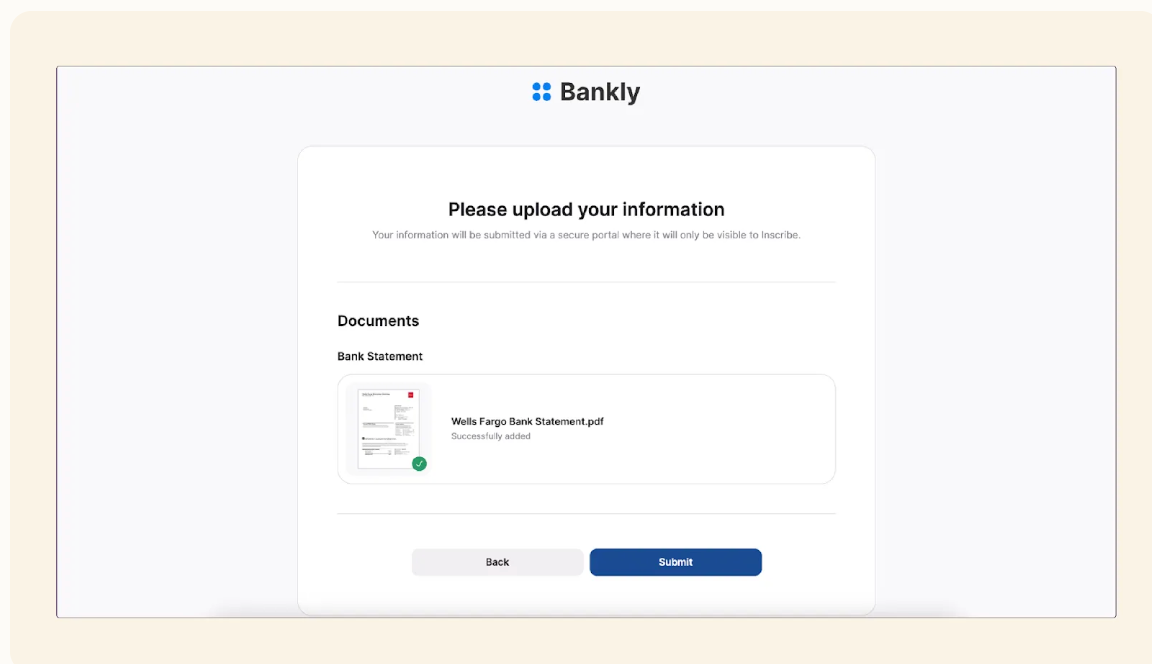
1) Submit bank statements
Upload PDF bank statements directly, connect via API, or request documents through Secure Document Collection. This reduces back-and-forth and improves chain of custody.
2) Extract and parse
Inscribe extracts financial data from PDF bank statements and scanned documents, then converts it into structured outputs your team can use immediately. It pulls transactions, running balances, deposits, withdrawals, and account details across bank accounts, and it supports analysis across multiple accounts when applicants submit more than one file.
Instead of raw data dumps, Inscribe applies machine learning to interpret statement layouts and transaction patterns, producing consistent extracted data even when formats vary across institutions. It can also apply AI-powered categorization to support expense analysis and cash flow insights, so reviewers get a clearer view of financial habits without rekeying data.
3) Validate and detect fraud
This is where Inscribe is fundamentally different from extraction-only statement analyzers:
- Metadata inspection
- Font anomaly detection
- Pixel-level image analysis
- Revision history extraction via Document X-Ray
- Network comparison against millions of analyzed documents
- Cross-document corroboration within an application
4) Review, report, and decide
Results return in a review-ready format, including a Trust Score (0–100), severity levels, highlighted fraud signals, and plain-language summaries. Teams can use these outputs for faster lending decisions and more consistent reporting, especially when review queues are high and processing time matters.
For businesses that need seamless integration, Inscribe provides structured data outputs that can flow into decisioning systems and downstream pipelines. Average processing time is about 72 seconds, so your process stays fast without gut-checks. Integration documentation is available at docs.inscribe.ai.
Key Features
AI-powered data extraction
Extract transactions, balances, income, expenses, and account details from bank statements across formats and institutions. Inscribe’s custom LLMs understand complex statement layouts — tables, multi-column formats, running balances — that break basic OCR tools. Structured data is delivered via API and webhooks for seamless integration into lending processes and downstream systems.
Document X-Ray — Forensic Fraud Detection
Document X-Ray surfaces forensic signals that manual review and extraction tools miss. It answers: Has this statement been edited? What changed? When did it change? It reveals revision history, editing software used, font inconsistencies, and metadata anomalies—pixel-level manipulation that’s invisible to manual review. No other bank statement analyser offers this level of forensic depth or these deep insights into document integrity.
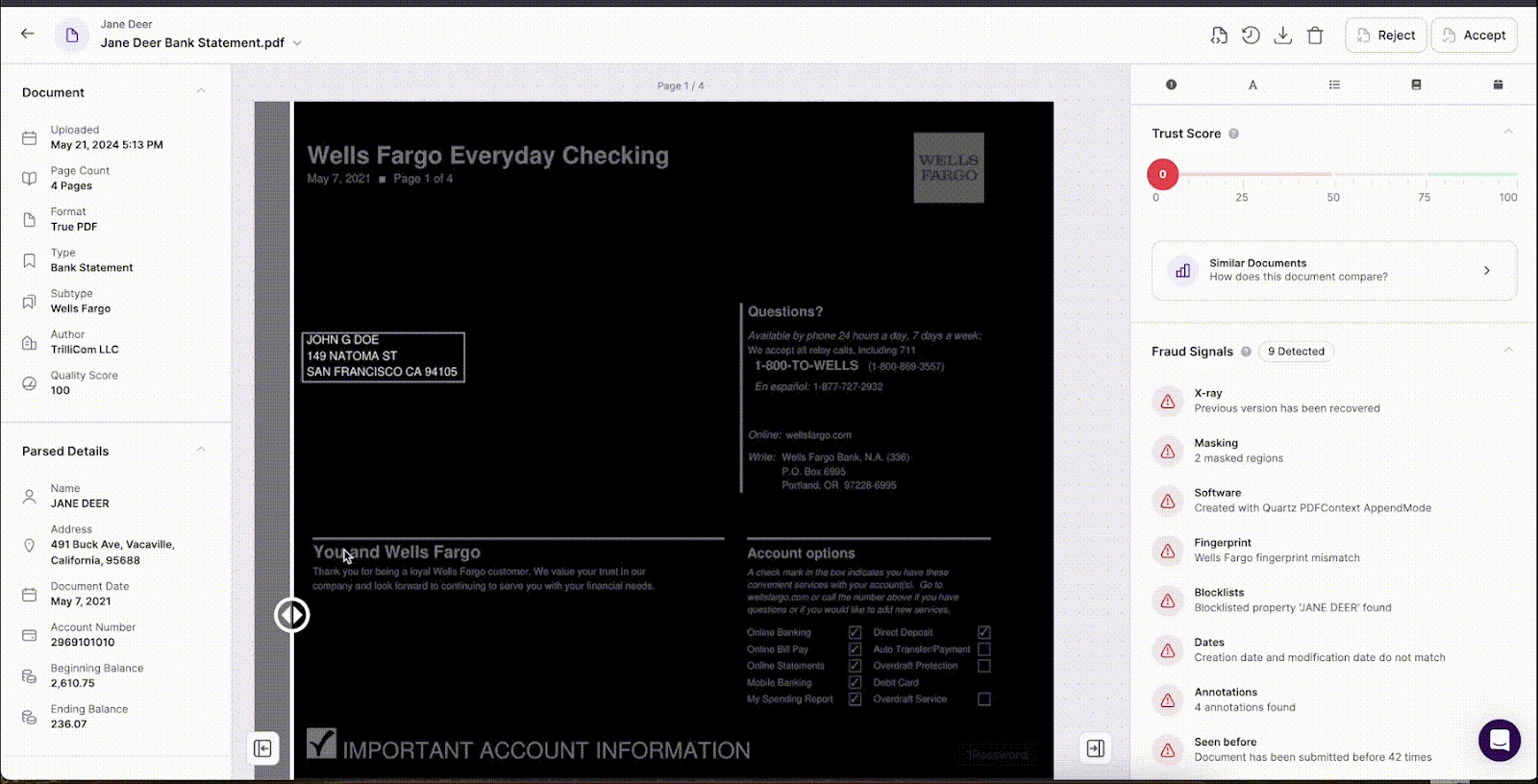
Trust Score and fraud signals
Every statement receives a Trust Score (0–100) based on the number and severity of detected fraud signals, plus plain-English explanations that clarify exactly what was flagged and why. This supports operational consistency, reduces reviewer guesswork, and creates audit-ready documentation for regulatory teams.
Network intelligence
Compare incoming statements against tens of millions of verified documents from thousands of financial institutions. Inscribe flags deviations from known-good templates, fonts, formats, and metadata patterns—catching template reuse and structural inconsistencies that a reviewer looking at a single file would never catch.
Financial insights and cash flow analysis
Move beyond raw data into deep insights: categorized transactions, income summaries, expense breakdowns, and cash flow trends that support more informed decisions. Powers lending decisioning with structured financial intelligence, not just raw extraction.
Cross-document corroboration
Automatically cross-check bank statement data against other financial documents in the same application—pay stubs, tax forms, proof of address—to surface contradictions, gaps, and suspicious inconsistencies. See the full process in the Agentic Fraud Detection Demo.
What’s the value?
Prevent fraud losses
Catch forged and fabricated bank statements before they turn into approved loans. Fraud prevention starts at the document level. Logix Federal Credit Union prevented over $3M in fraud losses using Inscribe. As Matt Overin, Manager of Fraud Risk Management at Logix FCU, puts it: “Today, with the internet and sophisticated tools to create any document you want, we really need something we can trust to look beyond what my investigators can see with the naked eye.”

Faster lending decisions
At about 72 seconds average processing vs. 10–15 minutes for manual review, Inscribe dramatically increases loan throughput without adding headcount. Customers at BHG Financial and BCU have seen document review become up to 50% faster while maintaining consistent quality.
Eliminate manual entry errors
AI extraction removes manual data entry entirely. No more transposition errors, missed transactions, or inconsistent formatting. Your team spends time reviewing exceptions, not rekeying data.
Better borrower experience
Faster decisions reduce friction and drop-off, especially in high-volume pipelines where speed affects conversion. Genuine customers get a smoother experience while fraud is stopped earlier.
Audit-ready documentation and security
Inscribe provides explainable outputs and evidence signals that support documentation and internal review. SOC 2 Type II and ISO 27001 certified. Read more about security posture details, legal, and privacy.
What Is the best bank statement analyzer?
For professional bank statement analysis, “best” means the tool helps you make decisions you can defend, at the speed your processes require. Use this framework—and see how Inscribe answers each:
1) Does it extract data AND detect fraud?
Most tools do one or the other. Inscribe does both—so you can verify document authenticity before trusting the extracted data. Extraction-only tools leave you with clean numbers from a potentially fake document.
2) Does it produce a comprehensive view, not just extracted data?
Extraction is table stakes. The tool should help reviewers understand cash flow and financial habits quickly, standardize decisions with clear outputs and reporting, and reduce processing time. Inscribe: yes—categorized transactions, income summaries, and cash flow trends are built in.
3) Can it handle real-world statement formats?
Look for support for PDF bank statements, scanned images, multi-page documents, and diverse layouts across thousands of institutions. Inscribe: yes—trained on tens of millions of real financial documents from institutions worldwide.
4) Does it explain its decisions?
Trust Scores plus plain-language summaries reduce reviewer guesswork and produce clearer reporting for audits. Inscribe: yes—every analysis includes a Trust Score (0–100) and natural language fraud signal explanations.
5) How fast is it at scale?
A tool can be “accurate” and still slow you down if it creates bottlenecks. Inscribe: ~72 seconds average per file, with API-based processing that supports high-volume pipelines.
6) Does it integrate cleanly into your process?
API-first integration, webhooks, and structured outputs matter for lending decisioning and automation. Inscribe: yes—REST endpoints, webhook support, and structured outputs for downstream systems. See why Inscribe for more on the platform.
7) Is it secure enough for sensitive financial documents?
Confirm certifications and data privacy controls. Inscribe: SOC 2 Type II + ISO 27001, with configurable retention and deletion policies. Details at trust.inscribe.ai.
Can AI analyze bank statements? (And why not ChatGPT?)
Yes, AI can analyze bank statements
AI can analyze bank statements with better consistency, speed, and depth than manual review—especially in underwriting and fraud processes where volume and accuracy both matter. Purpose-built AI risk agents are specifically trained on financial documents to deliver reliable results at scale.
Can ChatGPT analyze a bank statement?
Technically, yes. You can upload a file and ask ChatGPT to summarize it. But ChatGPT is a general-purpose tool, not bank statement analysis software, and it wasn’t built for lending, fraud detection, or regulatory decisioning.
Why ChatGPT is not the right tool for professional bank statement analysis
Here’s what matters in real underwriting processes:
- Data privacy: Uploading bank statements to ChatGPT means sending sensitive financial data to a general AI service, without financial-grade retention and deletion controls designed for your regulatory requirements.
- No forensic fraud detection: ChatGPT can’t inspect metadata, detect font anomalies, extract revision history, or identify forgery signals in the file itself.
- No audit trail: There are no built-in audit logs, Trust Scores, or evidence signals structured for regulators and internal governance.
- Inconsistent accuracy: General AI can miss transactions, mis-categorize activity, or produce unreliable summaries when formats vary.
- Doesn’t scale into pipelines: It can’t integrate into lending pipelines or process files in bulk with consistent outputs and routing.
Inscribe is purpose-built AI for bank statement analysis
Inscribe is trained on tens of millions of real financial documents and designed for fraud detection, underwriting, and regulatory processes. It’s API-first, built for pipeline integration, and built for audit-ready decisioning (and not chatting).
Ready to analyze bank statements with confidence?
Make faster, defensible decisions from bank statements with automated extraction, cash flow insights, and fraud detection.
👉 Explore the Demo Center
👉 Request a personalized demo
👉 To go deeper on bank statement fraud specifically, see Inscribe's fake bank statement detector
Frequently Asked Questions

A bank statement analyzer is AI-powered software that automatically extracts, categorizes, and analyzes transaction data from bank statements. Inscribe’s analyzer goes further by combining data extraction with forensic fraud detection to verify documents are authentic before using the data for lending or regulatory decisions.
Upload a PDF bank statement (or connect via API) and Inscribe extracts transaction data, income, expenses, and balances in seconds. At the same time, it runs forensic checks—metadata analysis, font inspection, revision history, and network comparison—to verify the file is authentic and unaltered, then returns results with a Trust Score and natural language summary.
The best bank statement analyzer combines data extraction with fraud detection. Most tools only extract data and can’t tell you if the document is real. Inscribe parses financial data and detects forged, fabricated, and AI-generated fake statements, making it purpose-built for lending, fraud, and regulatory teams.
Several AI tools can analyze bank statements, including purpose-built bank statement analysis software and general-purpose tools like ChatGPT. For professional processes, only purpose-built analyzers like Inscribe offer accurate extraction, forensic fraud detection, audit-grade trails, and enterprise security (SOC 2 Type II) required for regulated use.
ChatGPT can read and summarize a bank statement if you upload it, but it’s not designed for professional bank statement analysis. It can’t detect document fraud, doesn’t provide audit trails, lacks financial-document data controls, and can produce inconsistent results. For underwriting and fraud review, use a purpose-built bank statement analyser like Inscribe.
Uploading bank statements to ChatGPT raises data privacy concerns because it involves sending sensitive financial data to a general AI service without financial-grade retention, deletion, and regulatory controls. For sensitive documents, use a SOC 2 Type II certified tool designed for enterprise processes.
Apps that edit bank statements are commonly used to commit fraud by creating fake or altered financial documents to deceive lenders, landlords, or other institutions. Inscribe’s bank statement analyser is designed to detect these edits using forensic AI, including Document X-Ray, which can reveal what changed and what the original content was.
Yes. AI can detect fake bank statements by analyzing metadata, fonts, formatting, pixel-level manipulation, and revision history. Inscribe also uses network intelligence to compare files against millions of analyzed documents from thousands of financial institutions to catch deviations that human reviewers can’t see.
A bank statement analyzer can extract transaction details (dates, descriptions, amounts, running balances), bank account information, income summaries, expense categorizations, cash flow trends, and financial health indicators. Inscribe delivers extracted data via API for integration with lending platforms, accounting software, and risk models.
Inscribe analyzes a bank statement in about 72 seconds, including data extraction, fraud checks, and Trust Score generation. Manual review often takes 10–15 minutes per file, especially when reviewers must cross-check for inconsistencies. Inscribe processes documents via API in real time, supporting high-volume lending pipelines without bottlenecks.
About the author
Ronan Burke is the co-founder and CEO of Inscribe, where he has spent nearly a decade studying how fraud evolves and what it takes to stop it. His work sits at the intersection of generative AI and financial crime: specifically, how AI-powered reasoning can outpace the fraud tactics that have already outrun rules-based detection. He writes and speaks regularly on document fraud, agentic AI, and what it means to build fraud defenses for a world where fakes are cheap, fast, and convincing.
Learn More
Dive deeper into our Solutions


What will our AI Agents find in your documents?
Start your free trial to catch more fraud, faster.