

Why bank statement fraud is the #1 document concern for lenders in 2026
Table of Contents
[ show ]- Loading table of contents...


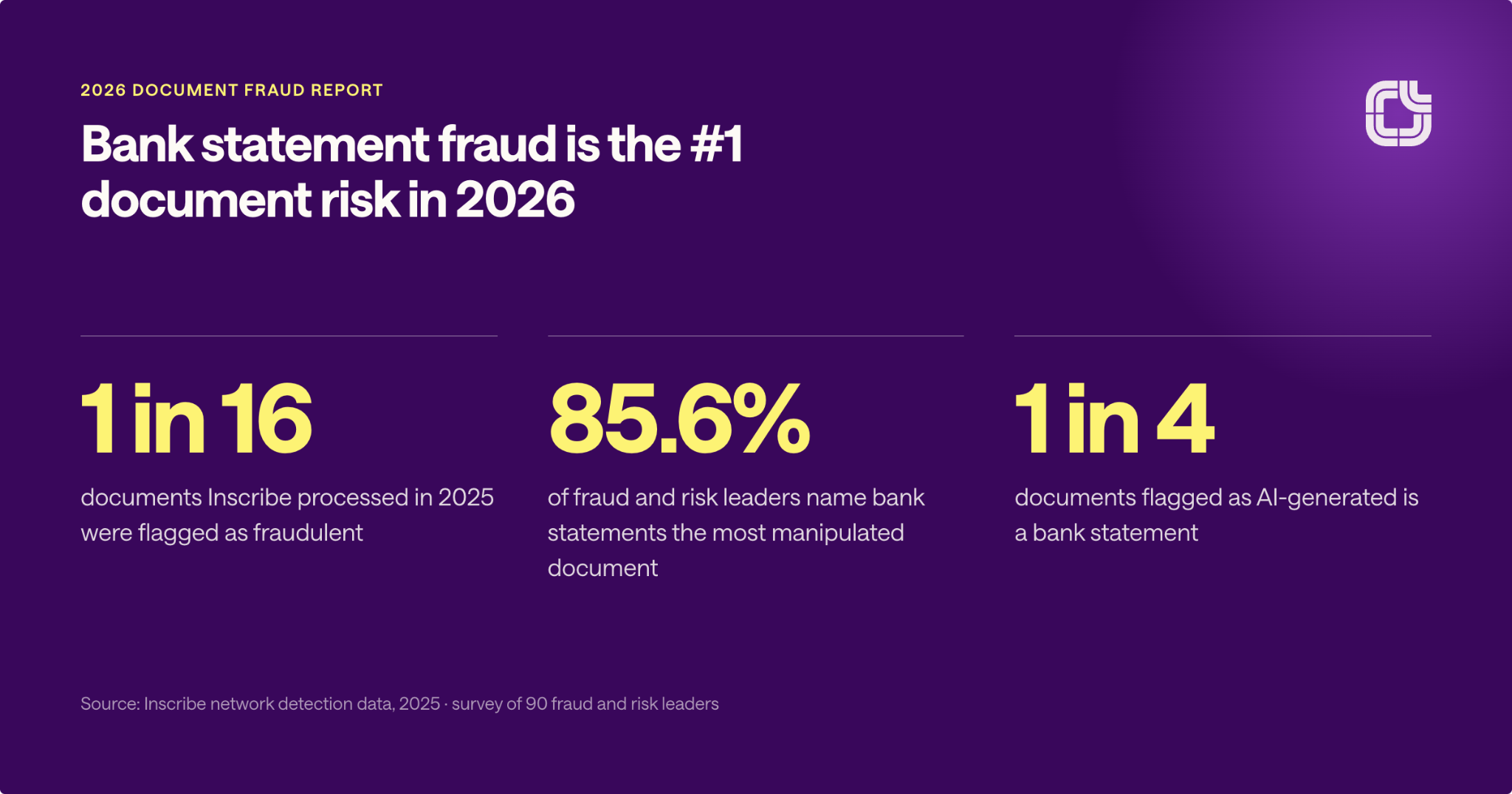
In 2025, Inscribe flagged roughly one in sixteen documents across its network as fraudulent, about 6% of everything processed across hundreds of banks, credit unions, fintechs, and lenders.
Ask the people who fight that fraud which document worries them most and the answer is close to unanimous.
In a survey of 90 fraud and risk leaders for the 2026 Document Fraud Report, 85.6% named bank statements the document type most vulnerable to manipulation, the highest of any category.
Bank statement fraud is the highest-concern document risk lenders and fintechs face at the point of underwriting, and the forged, edited, and AI-fabricated statements driving it slip past both bank feeds and manual review. Inscribe verifies that a submitted bank statement is authentic and unaltered before it reaches your credit decision.
Inscribe sits inside the bank statement analysis workflow as the authenticity layer your credit and risk teams can defend. The report data below shows why that layer matters more in 2026 than it did a year ago, and what it means for the way you onboard and underwrite.
What does the data show about bank statement fraud?
The data shows bank statement fraud is common, sustained, and aimed squarely at the financial details lenders underwrite against. The report draws on Inscribe network detection data spanning tens of millions of documents, the 90-person fraud leader survey, and interviews with senior underwriters, chief risk officers, and fraud managers. Three findings frame the problem.
Document fraud is part of weekly operations
Approximately 6% of all documents processed in 2025 were flagged, or roughly one in sixteen showing signs of manipulation, fabrication, or misrepresentation. The report puts that in lending terms: an organization processing 10,000 loan applications a year, with three documents each, is looking at more than 1,800 fraudulent documents annually. That works out to about 35 flagged documents to investigate every week, before holiday and promotional spikes.
Bank statements flag in the same band as other financial documents
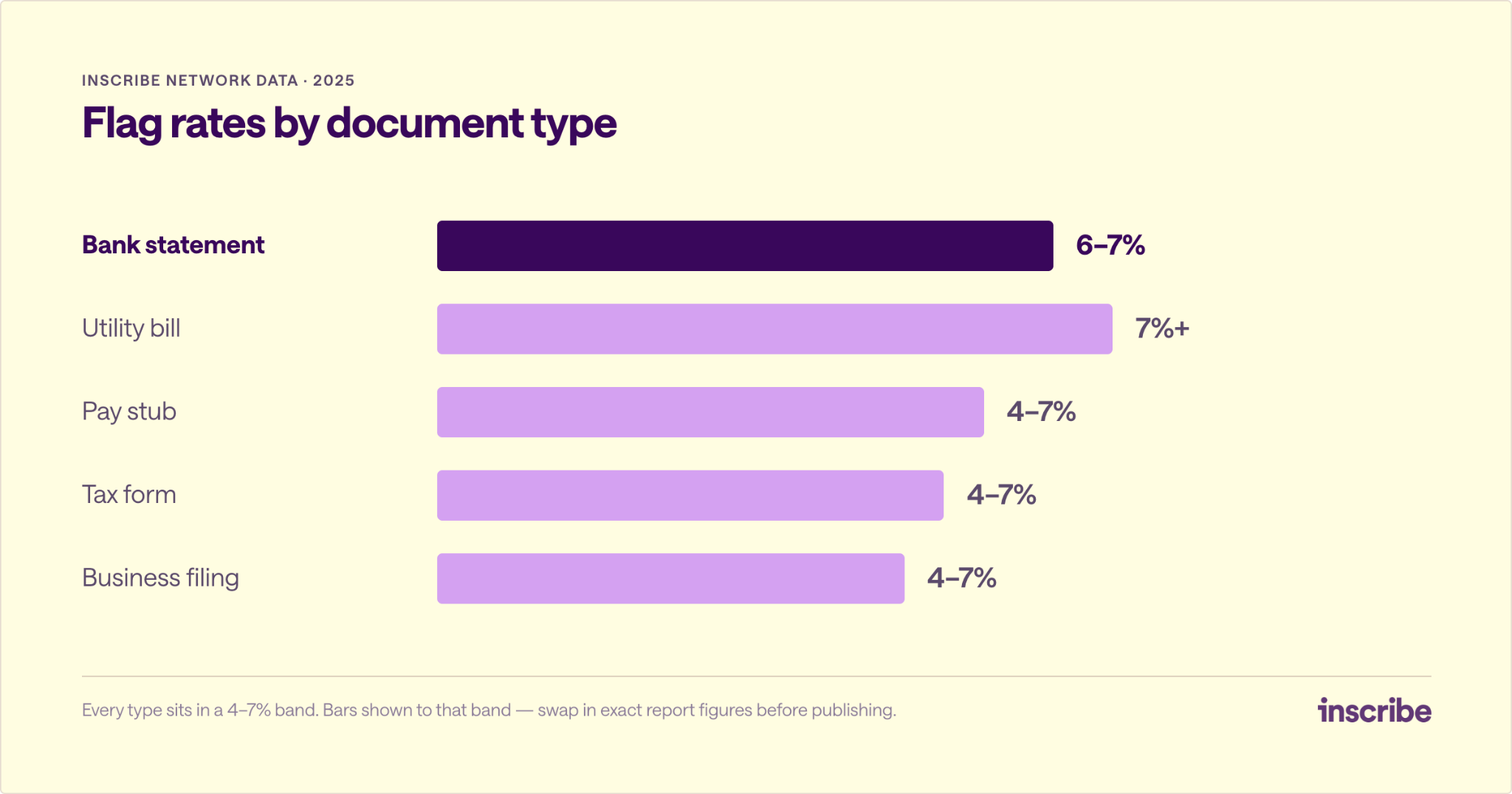
When the report breaks fraud rates out by document type, bank statements, pay stubs, tax forms, and business filings all cluster in a 4% to 7% baseline range. Bank statements sit near the middle of that band at roughly 6% to 7%.
Fraud pressure is broadly distributed across any workflow where a document is used to establish trust, which means the statement a borrower uploads at application is just as exposed as their pay stub or tax form.
Fraudsters are overwhelmingly editing the financial data
Of every document flagged as altered in 2025, 91.2% showed edits to the financial data: account balances, deposit amounts, withdrawals, and individual financial transactions. Only 8.8% involved identity-only edits. The share of documents carrying both identity and financial manipulation jumped from 40.2% in 2024 to 59.8% in 2025.

Read more: “What fraud trends are defining 2026?”
When a statement is faked, the details being altered are almost always the financial picture you are about to lend against.
Why are bank statements the top fraud concern for lenders?
Bank statements rank first because they are the most complex financial document to review and the most valuable one to fake. In the report's survey, 85.6% of fraud and risk leaders named them the document type most vulnerable to manipulation, the highest of any category. A pay stub has a handful of fields. A statement carries dozens of transactions, running balances, dates, and formatting elements, and every one of those is an opportunity for subtle manipulation and another thing a reviewer has to reconcile by eye.
Read more: “How do you evolve your fraud strategy in the age of AI?”
The other half of the answer is what a convincing statement unlocks: high-value credit approvals, business financing, and mortgage decisions. Jessica Lara, the Risk Operations Analyst who reviews documents flagged across Inscribe's network every day, put it plainly in Episode 27 of the Good Question podcast:
Pay stubs and business financial documents rank second and third, which maps directly to the income verification use case behind most lending fraud. The documents that demand the most scrutiny are also the ones that show up most often, so there is no low-volume segment to deprioritize.
Do supporting documents carry the same fraud risk?
Yes, and sometimes more. Bank statements draw the most concern, but utility bills, often submitted as proof of address, carry the highest flag rate of any document category in the report, partly because altering a secondary document feels less serious to the person doing it even though the risk to the financial institution is the same. If your reviewers unconsciously apply less scrutiny to those secondary files, they are exactly the ones worth a closer look. Applying consistent checks across every document an applicant submits, primary and supporting, closes that gap.
If you want the forgery signals specific to statements, the fake bank statement detector breaks down what Inscribe looks for, and how to spot a fake bank statement covers the manual tells that no longer hold up.
How is AI changing bank statement fraud?
AI is making fake bank statements cheaper to produce, faster to iterate, and harder to catch by eye, and bank statements are its most frequent target. Bank statements account for roughly one in four documents Inscribe flags as AI-generated, more than any other document type. From June 2025 to May 2026, Inscribe's network saw a roughly 4x increase in the monthly volume of AI-flagged documents, and the most recent months are the highest on record; the mid-year 2026 update tracks the full trajectory. Concern is near universal: 97.8% of fraud leaders say they are worried about AI-enabled document fraud.
A year ago, the tells were obvious. AI-generated statements looked like they were made in a spreadsheet: perfect table alignment, transaction amounts rounded to the dollar, payees labeled “groceries” instead of an actual merchant name. Real statements are messier. Real transactions read “Shell” and $47.13, and that messiness is part of the signal. Those tells are mostly gone now.
AI-generated and AI-edited statements are two different problems
Fully AI-generated statements are built from scratch with a prompt, a template service, or a purpose-built fraud tool, and the patterns, while increasingly subtle, remain detectable; Inscribe's AI Generated detector, live since April 2025, is built to catch them. AI-edited statements start from a real document with a few targeted fields changed, like a balance or an inflated deposit, so most of the file is genuine and passes surface-level review. Inscribe detects both, but the AI-edited category is not yet measurable in aggregate, and closing that measurement gap is a priority for the next annual report. Qualitatively it is the harder problem: when nearly everything in a file is authentic, the signals that matter live in metadata, transaction consistency, internal logic, and cross-document patterns.
The bank statement template economy keeps fraud cheap
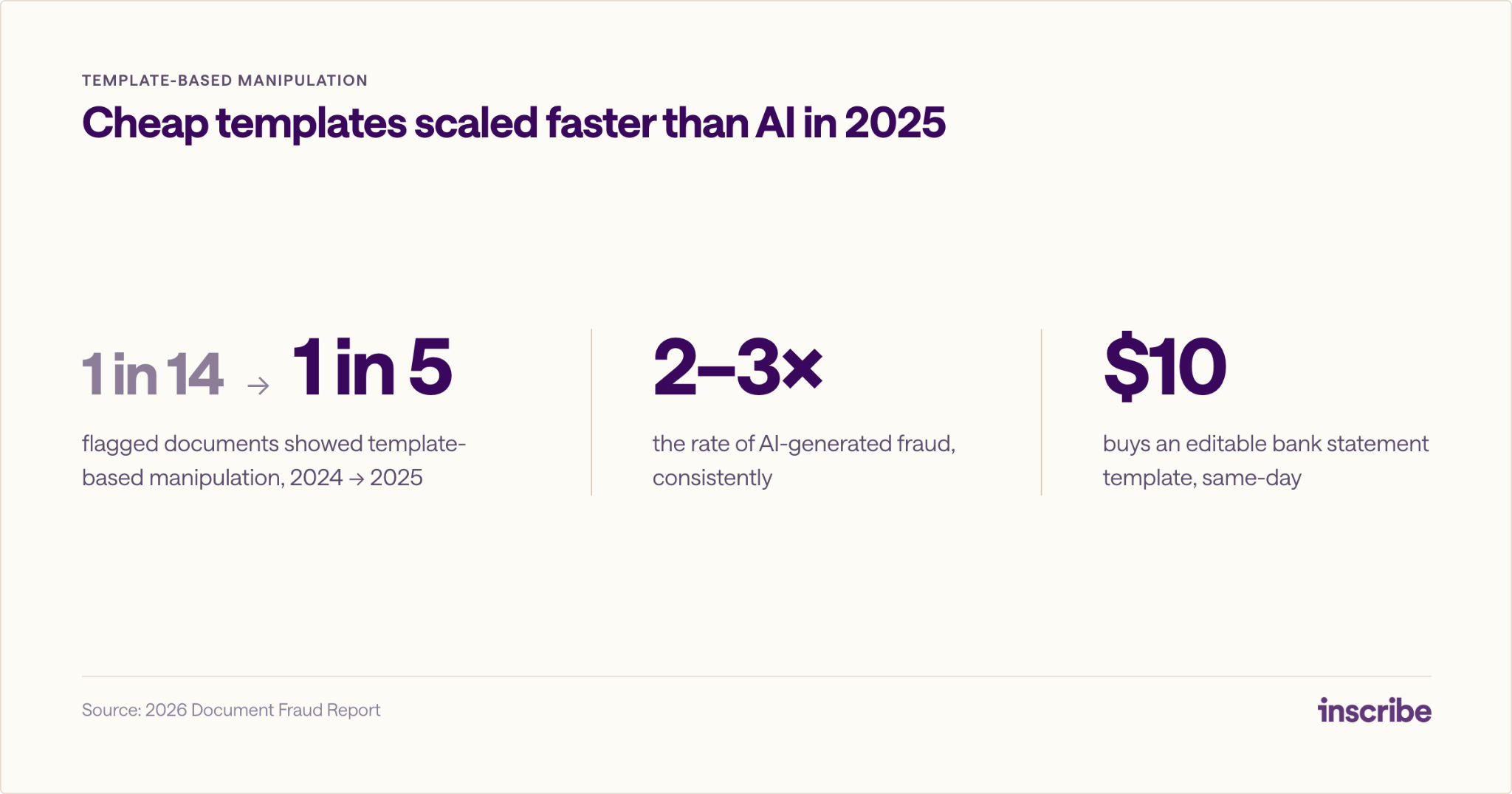
AI is only part of the pressure. Template-based fraud still runs at a rate 2 to 3x higher than AI-generated fraud, consistently, and sophisticated actors use both vectors, often in the same fraud wave. In 2025, 1 in 5 flagged documents showed template-based manipulation, up sharply from 1 in 14 in 2024.
A growing set of marketplaces sells editable bank statement templates for as little as $10, with same-day delivery and unlimited revisions. A fraudster with no technical skill can buy a template that mimics a real bank's layout, drop in a target's details, and submit the PDF.
A fraudster with no technical skill can buy a template that mimics a real bank's layout styles, drop in a target's details, and submit it in PDF format. The combination of cheap templates and AI editing has produced hybrid fakes that are neither fully synthetic nor simply purchased, and catching them takes detection built for both.
What does this mean at underwriting and onboarding?
For a lender or fintech, this data lands in one specific place: the moment between document collection and the credit decision. Two things break there as fraud scales.
Manual review stops scaling
Before automating, institutions in the report described spending 60 to 90 minutes per application on document review alone. The report runs the math on a conservative 45 minutes: across 200 daily applications, that is roughly 150 analyst-hours a day, the equivalent of nearly 20 full-time employees, just to check documents. That kind of manual review is time consuming and prone to human errors, and it does not scale. The old workflow of opening three or four statements side by side to compare account balances worked when fakes were crude. It does not work when AI makes the math add up, the formatting consistent, and the metadata clean.
Slow decisions cost you good customers
Speed decides which applicants you keep. When verification takes days and a competitor delivers faster approvals in hours, the strongest applicants and clients, the ones with real documentation and other options, go elsewhere, leaving a worse mix behind. The report frames the financial exposure with a worked example: 10,000 applications a month, 6% carrying fraud signals, a legacy miss rate of just 10%, $25,000 average exposure per approved application, and a 20% loss-realization rate produces roughly $3.6 million in annual fraud losses, about the fully loaded cost of a 15-person fraud team. That figure excludes manual review cost, customer churn, and downstream disputes.
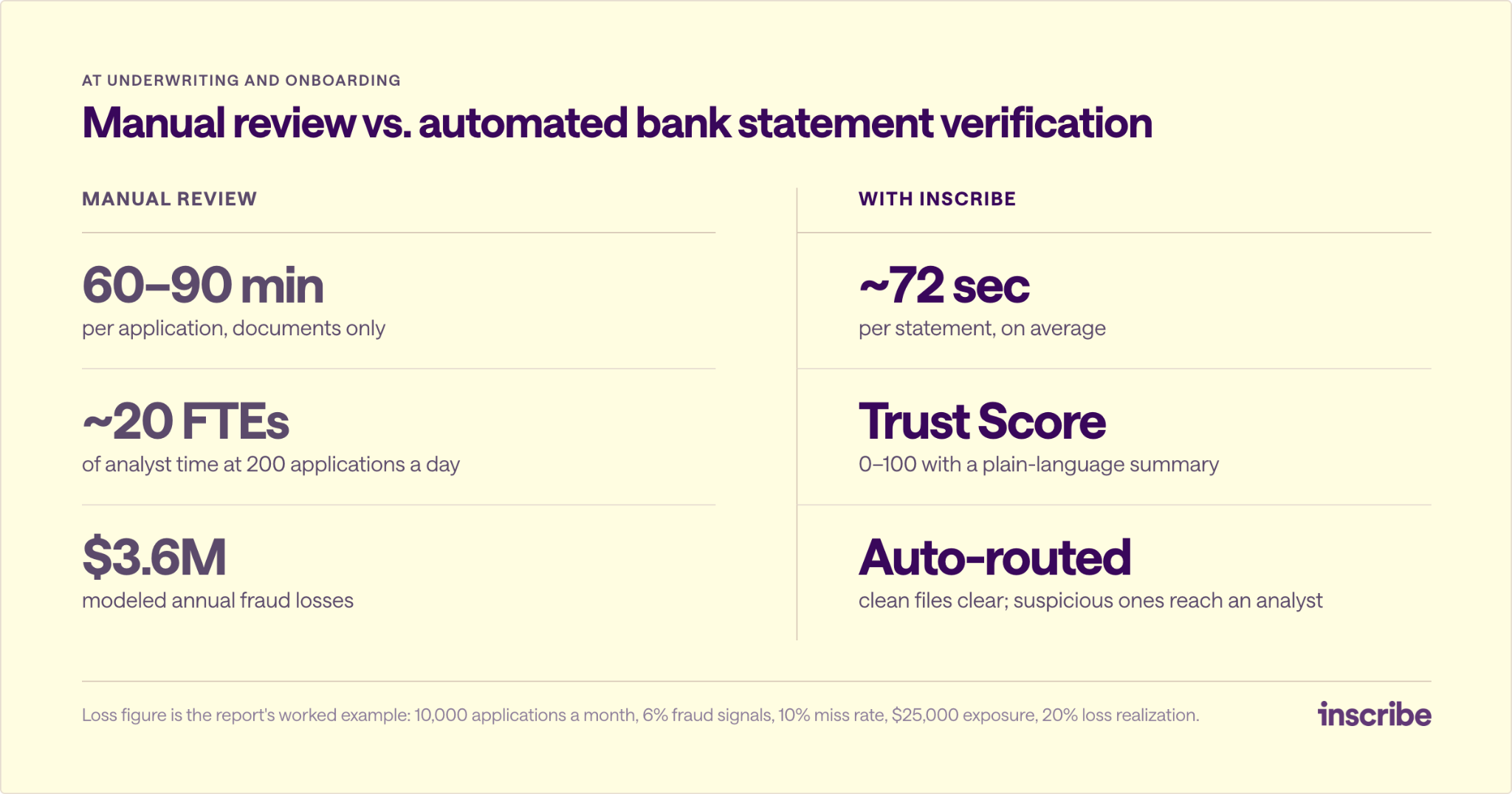
The goal at this step is simple: clear authentic statements automatically and route only the suspicious ones to a person. That is what automated bank statement verification does. Statements are collected at application or through Secure Document Collection, verified for authenticity, scored with a Trust Score and a plain-language summary an underwriter reads in seconds, then routed.
Low-risk files go straight to the Bank Statement Analyzer for data extraction and cash flow analysis, while high-risk files go to a fraud analyst with the evidence attached. Inscribe returns results in about 72 seconds per statement on average, compared with 10 to 15 minutes for manual review.
The same workflow extends beyond statements to pay stubs, tax returns, and other supporting documents, so your team can decide on the full applicant file rather than one document at a time.
How is AI-powered detection catching more fraud?
The report is clear that fraud teams can win this arms race. The same AI capabilities fraudsters use can be turned on detection. Inscribe's AI-powered approach combines machine learning across forensic, network, perceptual, and semantic signals, and the teams pulling ahead pair that scale with human judgment, layer defenses so document verification is one signal among identity, device, and behavioral controls, and share intelligence across financial institutions. The results are measurable.
What does bank statement fraud detection look for?
Bank statement fraud detection inspects what a document is made of rather than how it looks. It checks structure, metadata, and transaction dates for inconsistencies, including anomalies like odd-hour transactions or timing that does not fit a real account's history, compares each file against patterns seen across millions of account holders, checks an applicant's documents against each other for contradictions, and explains every signal in plain language so an analyst can act.
Inscribe's AI detects forged documents in seconds, returning a Trust Score from 0 to 100 and a summary an underwriter can read at a glance. Purpose-built for document risk screening since 2017, the platform is SOC 2 Type II and ISO 27001 certified, so verified financial data is handled with the security your compliance team expects, and it complements the review your team already does by automating the first pass. For fraud pressure beyond statements, document fraud detection software covers the full document set.
For fraud pressure beyond statements, document fraud detection software covers the full document set. That combination is what turns detection into prevention, and it is where the customer numbers come from.
- BCU prevented $80 million in losses in just the first nine months of 2025. In one case, a $75,000 auto loan was stopped after a bank statement was flagged for a fingerprint mismatch, a single signal that changed the outcome.
- Logix Federal Credit Union prevented more than $3 million in potential fraud losses in eight months, a figure Matt Overin, Manager of Fraud Risk Management, credits to Inscribe.
- Kinecta cut document review time by 99% and saved $850,000 in fraud losses. Jorge Cortes, Vice President of Enterprise Risk Management, says the platform has paid for itself many times over.
- BHG Financial, a non-bank lender, made document reviews over 90% faster, from 15 minutes per document to under a minute, and prevented millions in potential fraud losses. Michael Coomer, Director of Fraud Management, describes Inscribe as the inflection point that turned a manual, subjective process into a scalable, transparent system.
The pattern across these lenders is the same: verify the statement before it reaches the credit model, keep analysts focused on the files that warrant a second look, and catch inflated balances and fabricated deposits before they become approved loans. The strongest programs apply these checks across the entire customer lifecycle, from onboarding onward, so a manipulated statement is identified quickly even after an account is open. For business lending, that means checking a business bank statement and the financial stability it claims before underwriting a loan to small business owners. Across consumer and business lending alike, verification protects both your fraud losses and your good customers.
Ready to verify bank statements before you lend?
Make faster, defensible lending decisions by confirming every bank statement is authentic and unaltered before it reaches your credit model.
👉 Read the full 2026 Document Fraud Report
👉 Explore the Demo Center
FAQ

Inscribe flagged roughly one in sixteen documents, about 6%, as fraudulent across its network in 2025, and bank statements flag in the same 4% to 7% baseline band as other financial documents. Fraud pressure is broadly distributed, so any statement a borrower uploads carries real exposure. Inscribe verifies that a submitted statement is authentic and unaltered before it reaches your credit decision.
Yes. As AI improves the visual quality of fakes, the meaningful signals move below the surface. Inscribe applies forensic, network, perceptual, and semantic detection to flag metadata inconsistencies, font anomalies, pixel-level edits, recycled templates, and internal contradictions, each with a plain-language explanation for review and audit.
Yes. Bank statements account for roughly one in four documents Inscribe flags as AI-generated, and Inscribe's network saw a roughly 4x increase in the monthly volume of AI-flagged documents from June 2025 to May 2026. Inscribe detects both fully synthetic statements and AI-edited files where only a few fields were changed, and the system is tested against current fraud tactics.
A bank feed, or open banking connection, retrieves live transaction data from a linked account. It never sees the uploaded PDF where forgery happens. Bank statement fraud detection asks whether the document in front of you can be trusted. Many lenders use both: connectivity for accounts that link, and Inscribe to verify the statements that get uploaded instead.
Overwhelmingly financial ones. In 2025, 91.2% of flagged documents showed edits to financial details such as balances, deposits, withdrawals, and transactions, and the share carrying both identity and financial edits rose from 40.2% in 2024 to 59.8% in 2025. When a statement is faked, the financial picture is almost always the target.
Two ways. Template marketplaces sell editable bank statement templates for as little as $10 with same-day delivery, and 1 in 5 flagged documents in 2025 was template-based, up from 1 in 14 in 2024. Generative AI also lowers the barrier, both by producing statements and by coaching users through edits step by step. See how to spot a fake bank statement for the details.
Do not approve the application on a statement you cannot trust. Preserve the evidence, including the Trust Score and the signals that flagged the file, route it to your fraud or risk team for investigation, and follow your institution's process for confirmed fraud, which can include filing a Suspicious Activity Report with FinCEN or a complaint with the FTC. Inscribe attaches that evidence automatically, so the handoff to a human reviewer is fast and defensible.
Inscribe returns results in about 72 seconds per statement on average, compared with 10 to 15 minutes for manual review. Low-risk statements clear automatically to the Bank Statement Analyzer, while high-risk or low-confidence files route to a human reviewer with the supporting evidence attached.
The report's worked example assumes 10,000 applications a month, 6% carrying fraud signals, a 10% miss rate, $25,000 average exposure, and a 20% loss-realization rate, producing roughly $3.6 million in annual fraud losses, before manual review cost and customer churn. Customers using Inscribe report large preventions, including $80 million at BCU in nine months and more than $3 million at Logix Federal Credit Union in eight months.
About the author
Brianna Valleskey is a B2B marketing leader and Head of Marketing at Inscribe, where she leads the company's full marketing function and go-to-market strategy. She oversees brand, product marketing, demand generation, ABM, content, SEO/AEO, events, partnerships, and marketing operations, with responsibility for marketing pipeline and SQO targets. A former journalist and longtime storyteller, Brianna specializes in translating complex AI, fraud, identity, and fintech topics into clear narratives for enterprise audiences. She is the creator and host of Good Question, Inscribe's podcast on AI and fraud risk, and leads Inscribe's annual State of Document Fraud report.
What will our AI Agents find in your documents?
Start your free trial to catch more fraud, faster.