
Mortgage document processing: a lender's guide to document fraud
Table of Contents
[ show ]- Loading table of contents...


A mortgage file is the most document-heavy credit decision in consumer lending, and every page in it is an opportunity for misrepresentation. Cotality's National Mortgage Application Fraud Risk Index estimated that 1 in 119 mortgage applications showed indications of fraud risk in Q2 2026, rising to 1 in 44 for investment properties and 1 in 27 for multifamily, with purchase loans climbing to 72% of volume and bringing the full documentation burden back with them. The documents doing the heaviest lifting in that file, bank statements, pay stubs, W-2s, and tax returns, are the ones most often faked: across Inscribe's network, roughly 1 in 16 documents (about 6%) processed in 2025 showed signs of fraud.
Mortgage document processing is the work of collecting, classifying, verifying, and extracting data from the documents in a loan file. Done well, it includes a step most pipelines skip: confirming each document is authentic before its data is trusted. Inscribe adds that step with AI agents that detect altered, fabricated, and AI-generated borrower documents and explain every flag, so your processors and underwriters work from documents they can defend.
Inscribe has been purpose-built for document risk screening since 2017, is SOC 2 Type II and ISO 27001 certified, and is trusted by leading banks, credit unions, fintechs, and lenders. This page covers where fraud enters a mortgage file, how fraud-aware processing works, what regulators and the GSEs expect of document review, and how to evaluate vendors. The pages linked throughout go deeper on each document type and workflow, and the Demo Center shows the review itself.
What is mortgage document processing?
Mortgage document processing is the set of steps that turn the loan documents a borrower submits into validated data an underwriter can decide on: collecting the loan file, classifying and indexing each document type, confirming it is authentic and complete, extracting structured data from its fields, and running the calculations (income, assets, debt-to-income) that origination depends on. It runs across the mortgage lifecycle, from application through underwriting to closing, and in most lenders' stacks the work is split across a point-of-sale system, a loan origination system (LOS), a document automation vendor, and the people who reconcile what the software returns.
The order of those steps matters. Most mortgage document pipelines are built around throughput: index the pages, extract the fields, calculate the income, keep the file moving. Authentication, if it happens at all, is a reviewer looking at the document on screen. That leaves a gap between "we extracted this number" and "we know this number is real," and in a purchase-heavy market that gap is where losses originate.
Fraud-aware mortgage document processing closes the gap by verifying each document before extraction: one additional check, run automatically, at the point where it changes everything downstream. Inscribe is built to be that check. It sits between document collection and your LOS or underwriting system, returns a Trust Score for every document, and passes verified data forward. The broader category is covered on the document fraud detection software page; this page is about what that layer looks like inside a mortgage file.
How does intelligent document processing fit into mortgage lending?
Intelligent document processing (IDP) is the document AI layer most mortgage document automation is built on: machine learning and computer vision models that read scanned documents and native PDFs in any document format, classify each one, and extract structured data (key-value pairs, tables, line items) from unstructured documents so it can be validated against business rules and written to loan origination systems. In a mortgage process, that means a loan package of pay stubs, tax returns, bank statements, credit reports, appraisal reports, the purchase contract, and the loan estimate and closing disclosure gets labeled, parsed, and routed without manual data entry.
The operational case for IDP is well established. Mortgage process automation replaces repetitive tasks and error-prone manual processing with automated workflows, which cuts manual effort, reduces human error, improves processing speed and data quality, and leaves an audit trail of what was extracted and when. Lenders adopting mortgage data extraction tools typically measure the gains in operational efficiency: fewer touches per loan file, faster turnaround on required documents, and processors freed from manual tasks across the loan cycle.
What IDP does not do, by design, is decide whether the document it just read should be trusted. Data accuracy means the number on the page was captured correctly; it says nothing about whether the page was edited before upload. Cross-document validation catches a pay stub that disagrees with a W-2, but a fraudster who fabricates both from the same template passes it. Fraud-aware mortgage document processing adds document authentication ahead of extraction, so the structured data flowing into underwriting tools and existing systems comes from documents that have been verified as well as read. The rest of this page is about that step: where it sits in mortgage workflows, what it catches, and how to evaluate it alongside the automation you already run.
Which document types in a mortgage loan file are most often falsified?
Bank statements, pay stubs, tax forms, and business financials carry a similar baseline fraud rate, generally 4-7% of documents, across Inscribe's network, and all four appear in nearly every mortgage file. The 2026 Document Fraud Report found that 91.2% of altered documents include edits to financial details, and that 85.6% of the 90 fraud and risk leaders surveyed named bank statements as the document type they worry about most. Cotality's index tracks the same pressure from the application side: income, occupancy, and property misrepresentation are the categories that move its risk reading quarter to quarter. Inscribe's mid-year 2026 update adds the AI angle: bank statements account for roughly 1 in 4 documents flagged as AI-generated across the network, and the reason is what a convincing fake statement unlocks, including mortgage decisions.
The table below maps the documents in a standard mortgage file to how each one is typically faked and what tends to give it away.
The rest of the loan package originates with third parties rather than the borrower: credit reports, appraisal reports, the purchase contract, title documents, and the loan estimate and closing disclosure. Those are falsified less often at the document level, though appraisal and title fraud are tracked categories in Cotality's index, and they move through the same document workflows. A fraud-aware pipeline classifies and extracts all the documents in a single loan file and concentrates authentication where borrower-supplied documents carry the risk.
Mortgage fraud is almost always a file-level story told through multiple documents, which is why single-document checks miss it. Inflated income on a pay stub has to be supported by deposits on a bank statement, which have to be consistent with the W-2 and the tax return. Detection that corroborates across the file is the only kind that catches the version of fraud underwriters actually see. The document-by-document detail lives on loan document fraud detection, with dedicated guides on how to spot fake pay stubs and how to spot a fake W-2.
Why does document fraud get through automated document processing?
Document fraud gets through because mortgage pipelines are optimized to extract data quickly and accurately, and a perfectly extracted number from a fabricated statement is still wrong. Three things compound that design gap.
Extraction is not authentication. OCR, document AI, and intelligent document processing tools read a document and return extracted data; they do not decide whether it deserves to be trusted. A pay stub that reconciles internally will pass every field-level rule even if the employer does not exist. The fraud evidence lives in places extraction never looks: file metadata, revision history, pixel-level artifacts, and contradictions between documents.
Direct-source verification does not cover the whole file. Day 1 Certainty and automated verification of employment and income through The Work Number, bank-data aggregators, and similar services have reduced reliance on uploaded documents for salaried borrowers at employers that report payroll. Self-employed borrowers, gig and contractor income, small employers, gift funds, and most asset documentation still arrive as uploads. That residual set is exactly where document-originated fraud concentrates, because fraudsters know which path gets checked.
The documents are getting better. The monthly volume of AI-generated document fraud increased nearly fivefold between April and December 2025 across Inscribe's network, and the climb continued: roughly 4x from June 2025 to May 2026 per the mid-year update. Jessica Lara, Risk Operation Analyst on Inscribe's risk operations team, sees why mortgage-adjacent documents are the target.
"We see mostly bank statements being targeted for AI fraud. Bank statements are the definitive source of truth for income verification. You're almost always required to provide a bank statement if you're applying for any sort of financial product, and they can also serve as a proof of address."
Jessica Lara, Risk Operation Analyst, Inscribe
An AI-generated statement has clean math, plausible transactions, and no editing trail, because nothing was edited. It looks right to a reviewer and to a rule.
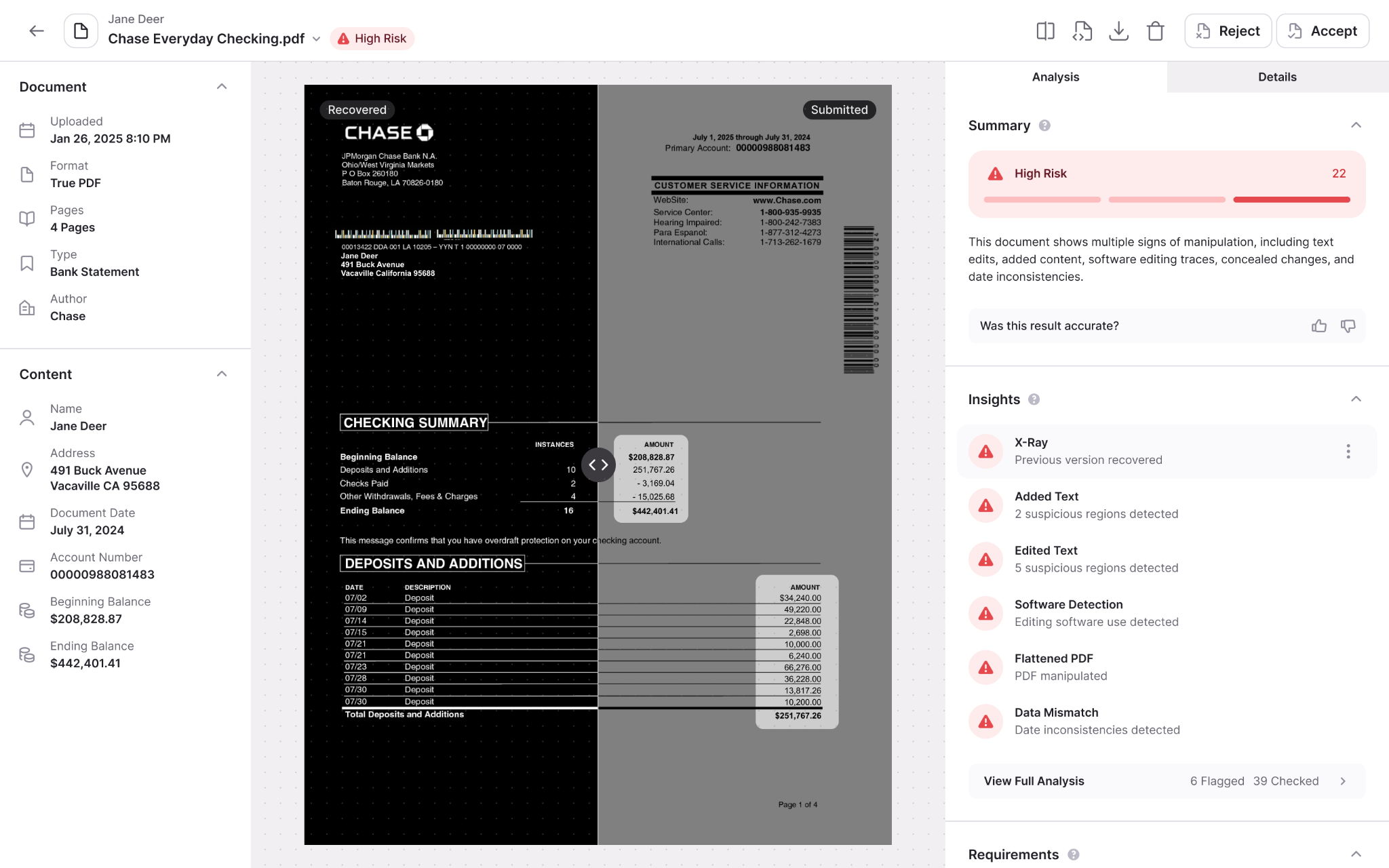
Human review of every document, the historical answer, does not scale to purchase-market volume. It is slow, error prone, and inconsistent, with results that vary by workload, experience, and fatigue. The visible cost is the queue. The larger cost is the file that clears review and later comes back as a repurchase demand.
How does fraud-aware mortgage document processing work?
Fraud-aware mortgage document processing runs authentication as a distinct, automated step between collection and extraction, so every document carries a trust decision into underwriting. With Inscribe, the sequence looks like this:
Step 1: Collect the loan file
Borrower documents arrive in every document format, from native PDFs to scanned documents and phone photos, through your point-of-sale or LOS, by API, from cloud storage links, or through Secure Document Collection links that replace email with an encrypted upload path and a cleaner chain of custody. Capture checks catch blur, glare, cropped edges, and missing pages before they become conditions.
Step 2: Document classification and completeness
Each file is identified by document type (bank statement, pay stub, W-2, tax return, ID, letter), and the labeled documents are checked against the required documents for the loan program, so a three-month statement request that came back as two months is flagged at intake rather than at underwriting.
Step 3: Authenticate every document
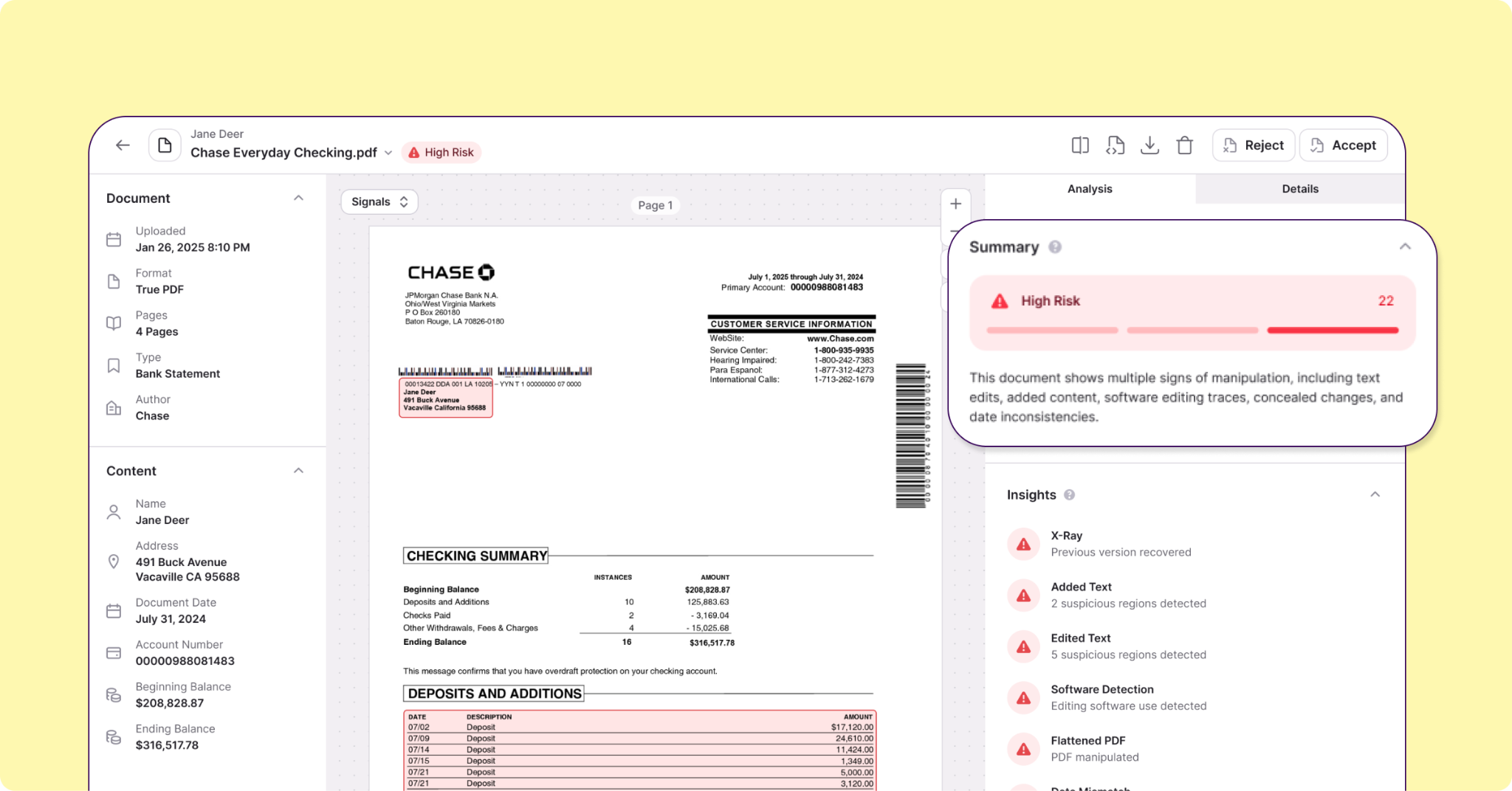
Inscribe's AI agents run four layers of detection on every document. Forensic detection inspects structure, fonts, metadata, and file history for tampering and synthetic generation. Network detection compares the document against patterns across the tens of millions of documents Inscribe has analyzed for banks, credit unions, fintechs, and lenders, catching recycled templates and layouts. Semantic detection reads the content and cross-checks names, addresses, employers, income, and balances across the file for contradictions. Perceptual detection examines the document at the pixel level for edits and AI-generation artifacts. Document X-Ray recovers revision history on edited PDFs, showing what the balance, name, or date was before it was changed.
Step 4: Data extraction from verified documents
Once a document is cleared, data extraction runs with LLM-based parsing that understands tables, multi-page layouts, and cross-page relationships, and extracts structured data as key-value pairs ready for your systems. Bank statement analysis returns deposits, withdrawals, running balances, days negative, and average daily balance; the Bank Statement Analyzer covers that step in depth. Validated data flows to your income calculation and LOS fields, replacing manual data entry.
Step 5: Explain the result and route documents
Every document returns a Trust Score from 0 to 100, severity levels, the specific signals found, and a plain-language summary of what was flagged and why. You set the thresholds: clean documents clear automatically, borderline files route to human review with the evidence attached, and high-risk files escalate to your fraud team as complete case files that feed your risk assessment. Every decision is logged, so built-in audit trails cover the review as well as the extraction.
The sequence is the differentiator. Workflow and analytics platforms run steps one, two, four, and a version of five well. Step three is where document-originated risk is caught or missed. Jorge Cortes, Vice President, Enterprise Risk Management at Kinecta Federal Credit Union, on what that step looks like in practice:

On average, documents are reviewed in about 72 seconds across Inscribe's network, against the 10-15 minutes manual review typically takes. Integration is API-first with webhook support and native options for decisioning platforms; documentation is at docs.inscribe.ai and current options are listed on the integrations page. The wider underwriting picture is covered in the loan underwriting guide.
What does a falsified document cost a mortgage lender?
A falsified document that reaches closing costs a mortgage lender in three ways: credit loss if the loan defaults, repurchase exposure if the loan was sold, and the operational cost of the investigation, the quality control findings, and the damage to investor relationships.
Repurchase is the cost specific to mortgage. Freddie Mac's March 2026 fraud reporting guidance states that mortgages with any misrepresentation, misstatement, or omission indicating fraud, suspected fraud, or suspicious activity are not eligible for sale to Freddie Mac, and refers seller/servicers to Guide Section 3601.1 for the repurchase implications of delivering such loans. Fannie Mae's Selling Guide section A3-4-03, updated December 2025, sets out seller/servicer obligations to prevent, detect, and report mortgage fraud. In both cases the loan file is the evidence, and a document altered before it reached the file is the lender's problem after the sale.
Lenders using document-level fraud detection report losses prevented at scale. BCU has prevented $80 million in losses with Inscribe, including $5.6 million from altered documents in the first nine months of 2025.
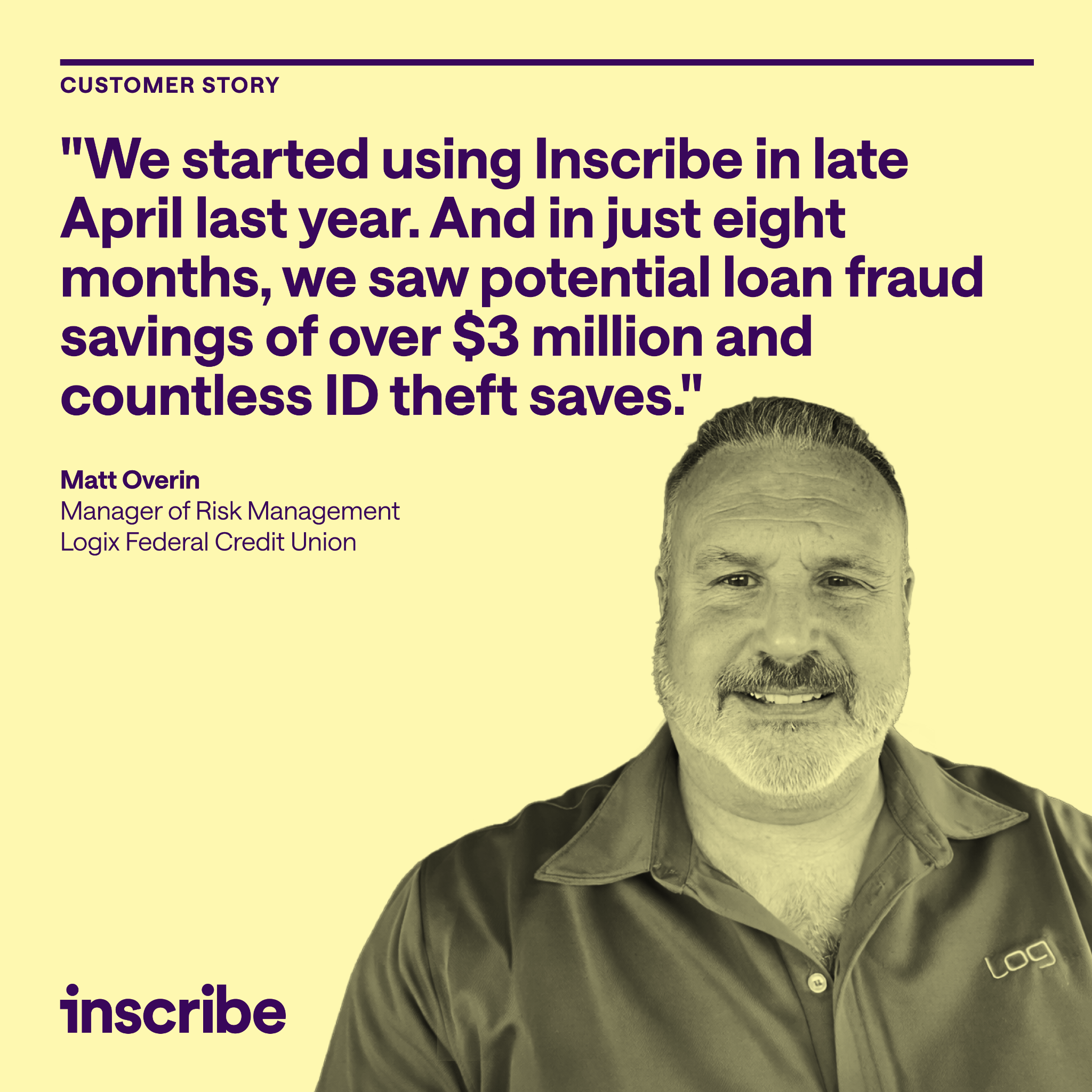
Matt Overin, Manager, Fraud Risk Management at Logix Federal Credit Union, saw potential loan fraud savings of over $3 million in eight months, and describes the shift: "Today, with the internet and sophisticated tools to create any document you want, we really need something we can trust to look beyond what my investigators can see with the naked eye."
What compliance risks do regulators and the GSEs expect mortgage document review to address?
Regulators and the GSEs expect mortgage lenders to verify the information they rely on using reliable records, to apply that verification consistently, and to be able to show their work. No single rule requires a specific fraud detection technology, but several set the standard your document review has to meet, and the compliance risks of missing it range from repurchase demands to examination findings.
Two practical notes. Regulation Z's third-party records standard is about reliability, and a borrower-uploaded bank statement is only as reliable as your ability to confirm it was not edited. And consistency is the compliance anchor under Regulation B: a fraud program that depends on which reviewer opened the file is hard to defend in an exam. Inscribe's security posture, retention controls, and certifications are documented at trust.inscribe.ai.
How do document AI and mortgage document processing vendors differ?
Mortgage document processing vendors differ by which step of the pipeline they own, and most lenders use several of them together. The categories below are complementary; the question for your stack is whether any of them authenticates the documents your borrowers upload.
Inscribe is the document layer in that stack: it confirms the documents feeding your LOS and income calculation tools are real, then passes verified data to them. Plaid, an Inscribe customer, routes uploaded documents through Inscribe inside its income verification product, so the lenders on its platform get cleared documents in seconds instead of days. That is the pattern: verification embedded where documents already flow, with no new place for your team to log in.
Why do you need document fraud detection if you already use DU, LPA, and VOE services?
You need document fraud detection because automated underwriting systems and verification services evaluate the data in the application and the data they can pull from the source; neither examines the uploaded document itself. Desktop Underwriter and Loan Product Advisor flag inconsistencies in what was entered. The Work Number and bank-data aggregators cover the borrowers and accounts they can reach. The uploaded PDF that fills the gap for everyone else, the Schedule C filer, the contractor, the gift letter, the asset statement from a smaller institution, is reviewed by a person or not at all.
That residual document set is where fraud concentrates, because it is the path with the fewest automated checks. Fraud-aware document processing is the control for that path, and it strengthens the services you already use: a verified income document reconciled against verified deposits gives your AUS findings a cleaner foundation. If you are already running Encompass, Ocrolus, or a VOE waterfall, Inscribe adds one step to that flow rather than a parallel process. The AI fraud agents page covers how the agents work across document types; document verification for lenders covers the lender workflow end to end.
What results do lenders see from fraud-aware document processing?
Lenders that add document authentication to their document workflows, whether those are still manual workflows or already automated, report losses prevented, review time cut by the majority, and manual effort reduced to an exception list instead of a backlog. Kinecta Federal Credit Union prevented $850,000 in potential fraud losses and reduced document review time by 99%. Logix Federal Credit Union saw potential loan fraud savings of over $3 million in eight months, and BCU's $80 million in prevented losses is covered above. Michael Coomer, Director of Fraud Management at BHG Financial, reports that BHG reduced manual document review time by more than 90%.
The pattern is the same across all of them: authentic borrowers move faster, processors review exceptions with the evidence attached, fraud teams see fewer and better-qualified escalations, and files reach investors with a documented rationale for every document. Industry context for each audience is on the lenders, credit unions, and banks pages.
How should you evaluate mortgage document processing software?
Evaluate mortgage document processing software on whether it authenticates documents before extracting their data, how it explains what it finds, and how cleanly it fits the stack you already run. Six questions separate vendors quickly:
- Does it verify authenticity, or only extract structured data? Ask for the specific signals it checks: metadata, revision history, template reuse, pixel-level edits, AI-generation artifacts, and cross-document contradictions. If the answer is "data validation," that is extraction with rules on top.
- Does it cover the full mortgage document mix? Bank statements, pay stubs, W-2s, 1099s, 1040s with schedules, business financials, employment letters, gift letters, and IDs, arriving as true PDFs, scans, and phone photos.
- Does it corroborate across the file? Mortgage fraud is a multi-document story. Single-document scoring misses the inflated pay stub that is contradicted by the deposits two documents later.
- Can your team and your examiners understand the output? Look for a score, severity, named signals, and a plain-language summary, so a processor can act and a compliance officer can defend the decision later.
- Does it fit the existing systems and team processes you already have? API and webhooks, LOS and decisioning integrations, and configurable routing thresholds, so verified documents clear automatically and only exceptions reach a person. Confirm implementation effort against your engineering capacity; most lenders have less than they would like.
- Is the vendor's security posture defensible? SOC 2 Type II and ISO 27001 certification, documented retention and deletion controls, and a public trust center.
The online document verification page goes deeper for teams comparing identity-only tools with document-level verification.
Where can you go deeper on mortgage document fraud?
Each page below takes one part of the mortgage document pipeline further, from the lender's view of the problem to the specific document types and workflows.
- How mortgage lenders can reduce fraud and loan defaults: the four steps lenders are taking to cut fraud and buybacks, with Cotality's latest data.
- Loan document fraud detection: fraud signals by document type.
- Proof of income fraud detection for lenders: catching inflated and fabricated income documents at origination.
- Underwriting document review automation: verifying, extracting, and routing borrower documents so underwriters review exceptions instead of everything.
- Fake bank statement detector: how edited and generated statements are identified.
- 2026 Document Fraud Report: the data behind the fraud rates on this page.
For the broader context, AI fraud detection for lenders covers the detection layer across all lending products, and bank statement analysis software covers the document mortgage underwriters weigh most heavily.
To see the authentication step on a real mortgage document, the Demo Center walks through intake to Trust Score end to end.
Frequently asked questions about mortgage document processing

Mortgage document processing is the work of collecting, classifying, verifying, and extracting data from the documents in a loan file so underwriters can decide on verified information. Fraud-aware processing adds an authentication step before extraction: Inscribe's AI agents detect altered, fabricated, and AI-generated borrower documents and explain every flag, so the data reaching your LOS comes from documents you can defend.
Bank statements, pay stubs, W-2s, tax returns, and business financials carry similar fraud rates, generally 4-7% of documents across Inscribe's network, and 91.2% of altered documents include edits to financial details. Fraud and risk leaders surveyed for the 2026 Document Fraud Report named bank statements as their top concern (85.6%), with pay stubs and business financials next.
Intelligent document processing reads loan documents: it classifies them, extracts structured data from them, validates that data against business rules, and routes it to existing systems. Mortgage document fraud detection decides whether each document deserves to be trusted in the first place, by inspecting metadata, revision history, template reuse, pixel-level edits, and contradictions across the loan file. The two are complementary; fraud detection runs ahead of extraction so the data IDP produces comes from verified documents.
Mortgage document automation reduces manual data entry, human error, and processing time, and it improves data quality, but it does not by itself reduce document fraud. A fabricated pay stub that reconciles internally extracts cleanly and passes cross-document validation if the matching W-2 was fabricated too. Fraud goes down when the automated workflow includes a document authentication step with a logged rationale, which is what fraud-aware mortgage document processing adds.
Yes. AI-generated documents leave signals in how the file was made and how it looks: metadata associated with generation tools, formatting and language patterns, perfectly rounded transactions, and generic descriptions. Inscribe's AI agents combine forensic, network, semantic, and perceptual detection to catch generated documents that have no editing trail. The monthly volume of AI-generated document fraud across Inscribe's network increased nearly fivefold between April and December 2025.
A loan sold to Fannie Mae or Freddie Mac with misrepresentation in the file can be subject to repurchase. Freddie Mac's guidance states that mortgages with misrepresentation indicating fraud are not eligible for sale and points to Guide Section 3601.1 for repurchase implications, and Fannie Mae's Selling Guide A3-4-03 sets out seller/servicer obligations to prevent and detect fraud. Authenticating documents at intake keeps misrepresented files out of delivery and creates the record investors and auditors expect.
It supports it. Regulation Z (12 CFR 1026.43) requires creditors to verify income and assets using reasonably reliable third-party records such as financial institution records and tax transcripts. A borrower-uploaded statement is only as reliable as your ability to confirm it was not altered. Document authentication provides that confirmation and a logged rationale for each file; your compliance team determines how it fits your ATR procedures.
No. Inscribe is the document layer that sits between collection and your LOS, decisioning, or income calculation tools. It confirms each document is authentic, extracts its data, and passes verified fields forward through API, webhooks, and native integrations. Lenders running Encompass, Ocrolus, or a VOE waterfall add Inscribe as a step in that flow rather than a parallel system.
About 72 seconds per document on average across Inscribe's network, compared with 10-15 minutes per document in manual review. In high-volume integrations the step runs faster: Plaid receives a decision on each submitted document in under 30 seconds. Clean documents clear automatically at the thresholds you set, so most of a mortgage file never waits on a person.
Kinecta Federal Credit Union prevented $850,000 in potential fraud losses and cut document review time by 99%. BCU has prevented $80 million in losses with Inscribe. Logix Federal Credit Union saw potential loan fraud savings of over $3 million in eight months, and BHG Financial reduced manual document review time by more than 90%.
Authentication before extraction, coverage of the full mortgage document mix, cross-document corroboration, explainable output a processor and an examiner can both use, integration with the LOS and verification services already in place, and a defensible security posture. Inscribe is SOC 2 Type II and ISO 27001 certified and returns a Trust Score, named signals, and a plain-language summary for every document.
About the author
Ronan Burke is the co-founder and CEO of Inscribe, where he has spent nearly a decade studying how fraud evolves and what it takes to stop it. His work sits at the intersection of generative AI and financial crime: specifically, how AI-powered reasoning can outpace the fraud tactics that have already outrun rules-based detection. He writes and speaks regularly on document fraud, agentic AI, and what it means to build fraud defenses for a world where fakes are cheap, fast, and convincing.
What will our AI Agents find in your documents?
Start your free trial to catch more fraud, faster.


