
Inscribe vs. Resistant AI: Which Document Fraud Detection Platform Is Right for Your Team?
Inscribe and Resistant AI are both document fraud detection platforms, but they are built around different operating philosophies and serve different buyer profiles.
Table of Contents
[ show ]- Loading table of contents...


Inscribe and Resistant AI are both document fraud detection platforms, but they are built around different operating philosophies and serve different buyer profiles. Inscribe is built around a unified workflow for U.S.-focused lenders that combines fraud detection, document parsing, and applicant level context in one system. Resistant AI concentrates on granular document-level forensics, with particularly strong coverage for European financial institutions. Neither platform is universally better. The right fit depends on your team's geographic focus, document mix, existing tech stack, and operational priorities.
A fraud analyst reviewing 200+ applications a day needs faster ways to identify fraudulent documents, prioritize real risk, and reduce manual review without missing sophisticated fraud attempts. Generative AI has made fake documents, altered bank statements, forged pay stubs, and manipulated PDFs easier to produce at scale. At the same time, the cost of addressing fraud for financial institutions has risen from $3.64 per dollar of fraud in 2020 to $4.41 in 2023, a 21% increase over four years.
Below is a practical comparison of both platforms across signal approach, parsing, applicant context, integrations, pricing, and geographic fit.
What Does Good Document Fraud Detection Actually Look Like?
The core tradeoff in any fraud detection platform is signal quality versus signal volume.
Too few signals miss sophisticated fraud attempts. Too many low confidence signals bury reviewers in manual work. The best platforms surface the signals most likely to change a decision, even when analyzing millions of documents.
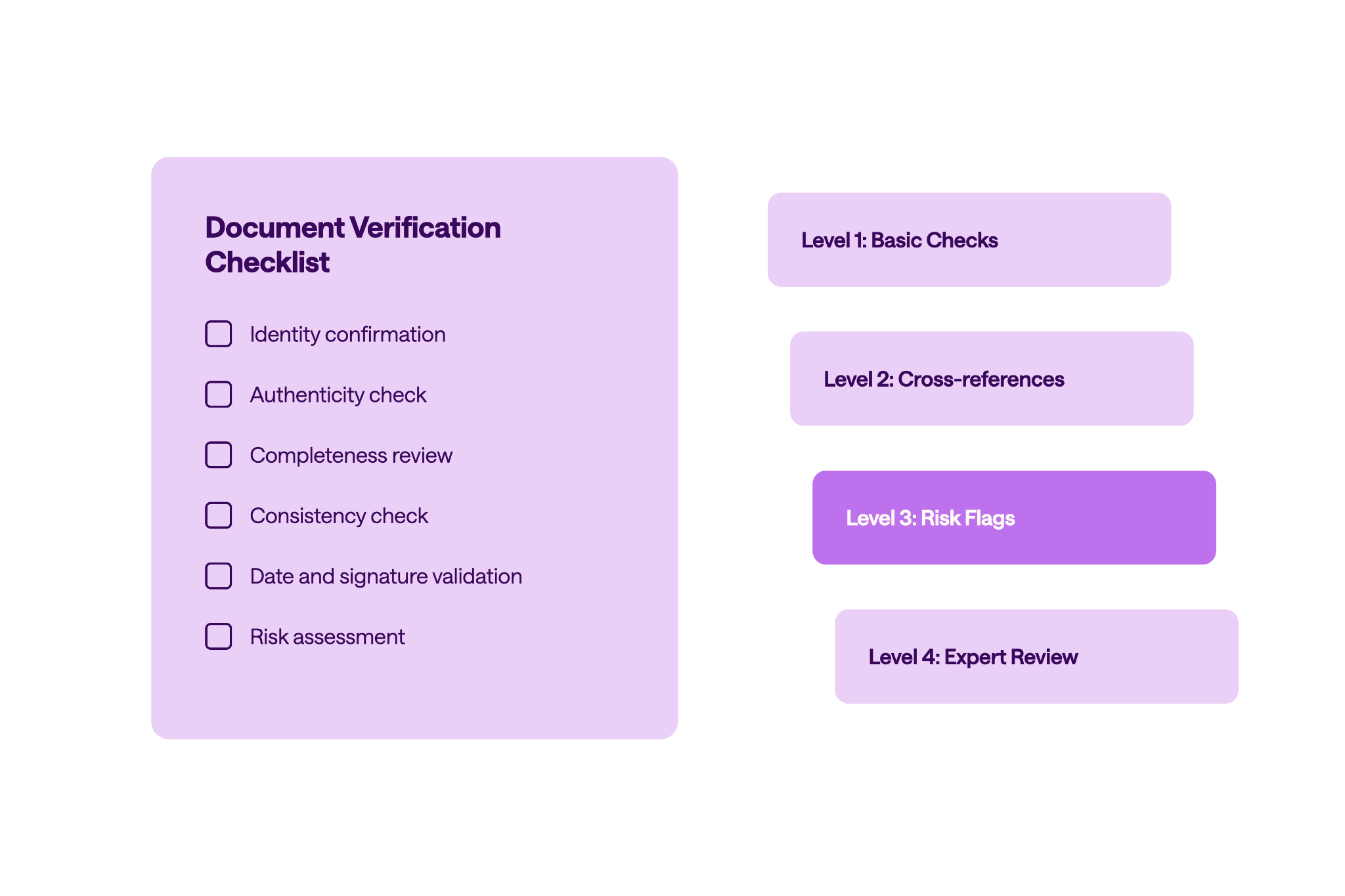
Strong document fraud detection platforms typically combine multiple verification layers:
- Pixel-level analysis to identify anomalies, subtle alterations, image splicing, compression artifacts, and inconsistent fonts
- Metadata examination to detect software signatures, edit history, timestamp conflicts, and metadata anomalies
- Structural analysis of document layouts, tables, logos, and repeated templates
- OCR and NLP for text extraction, semantic checks, and mismatched data
- Cross-document reasoning to validate claims across bank statements, pay stubs, tax returns, invoices, and identity documents
- Network analysis to identify template reuse, fraud rings, and emerging patterns across large document datasets
OCR and parsing capability is one of the clearest dividing lines between platforms. Some tools analyze documents for authenticity: whether a file has been manipulated, whether its structure looks suspicious, whether metadata has been altered. Others also perform native data extraction, reading fields, balances, transactions, income, employer names, and relationships between documents. Both approaches have legitimate use cases depending on what a team already has in its stack.
Applicant level context is a second major dividing line. A pay stub may look authentic on its own, but the deposit stream in the accompanying bank statements may not support the claimed income. Platforms that reason across multiple documents in a single application catch patterns that single-document checks miss. Platforms that focus on per-document forensic depth offer more granular evidence about individual files.
Geographic coverage should be treated as a fit consideration, not a universal ranking. A team reviewing U.S. bank statements, W-2s, and 1099s has different needs than a team reviewing EU identity documents, multi-language financial documents, or region-specific document formats. Both Inscribe and Resistant AI have clearly defined geographic strengths, and both have corresponding coverage gaps outside those areas.
When Is Resistant AI the Right Choice?
Resistant AI is best suited to organizations that need deep document-level forensic analysis, particularly financial institutions operating in Europe or across many document types and languages.
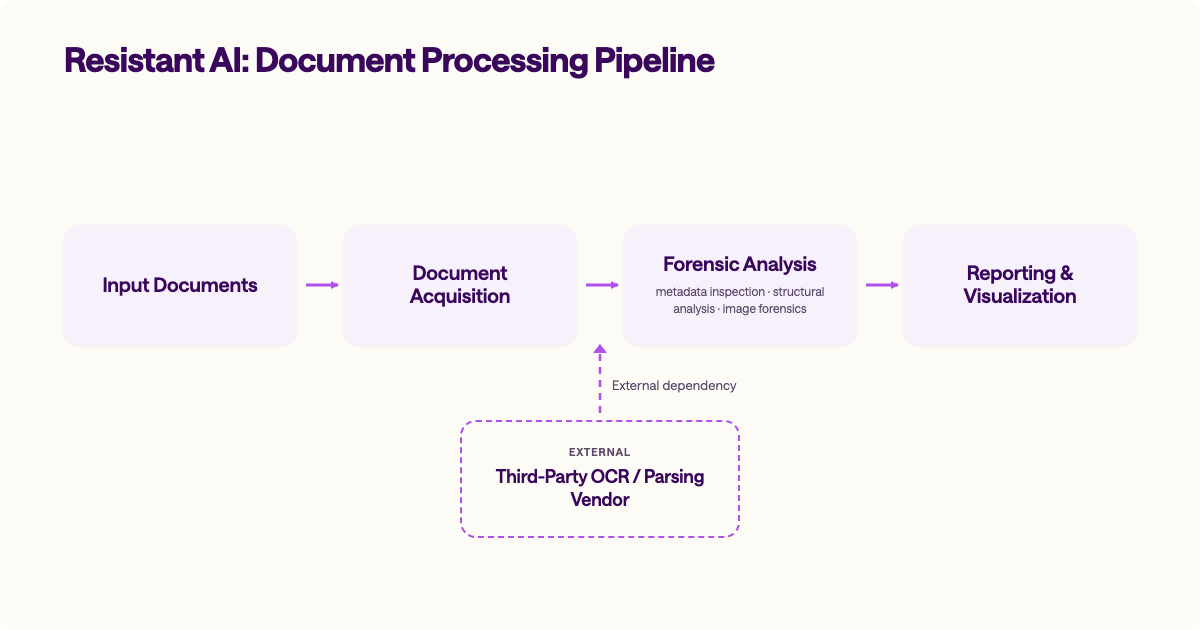
Its strengths are clearest around document authenticity. Resistant AI emphasizes document analysis, metadata checks, structural inspection, image forensics, format manipulation detection, template reuse detection, and network-based fraud signals. For teams dealing with AI-generated documents, fake documents, and forged or counterfeit documents across varied international formats, that forensic depth is a strong fit.
Resistant AI's approach is most useful when risk teams want granular evidence about a specific document:
- Was the document edited after creation?
- Are there signs of metadata tampering?
- Do visual elements show pixel-level inconsistencies?
- Does the document structure resemble known fraud patterns?
- Are there signals of format hopping, generated documents, or reused templates?
Public materials position Resistant AI as language- and document-agnostic, which is particularly relevant for EU markets where document formats, local languages, identity verification standards, and regulatory requirements vary widely. For teams with a broad international document mix, that coverage is a meaningful advantage.
When evaluating any platform that emphasizes deep forensic signals, it's worth asking how those outputs will fit into your existing escalation workflows. A rich set of fraud indicators delivers value only if reviewers can translate them into operational decisions, so teams already managing high alert volumes should assess how signal volume, risk thresholds, and escalation rules will be configured before committing.
As with any platform evaluation, it's worth testing OCR and parsing performance against your actual document types before committing. Resistant AI's public materials and product pages emphasize authenticity, metadata analysis, and anomaly detection as core capabilities. Teams that also need full native extraction of transaction data, income fields, balances, or applicant-level financial relationships should confirm directly with Resistant AI whether those extraction needs are covered, or whether a separate parsing vendor would be required.
Pricing should be confirmed directly with Resistant AI. Public sources don't clearly disclose whether pricing is per-user, usage-based, flat, or hybrid, so buyers should model cost at expected document volume and reviewer count before committing.
Resistant AI is strongest when:
- The team needs granular document-level signal depth
- The organization operates heavily in European markets
- The document mix spans many countries, languages, and document formats
- Analysts are comfortable interpreting detailed forensic indicators
- Existing operations already include separate OCR, data extraction, or underwriting systems
It may require more evaluation when:
- The team needs native parsing of U.S. financial documents as a core workflow requirement
- The team wants applicant-level risk profiles rather than document-only signals
- The buyer wants fully transparent public pricing before vendor evaluation
When Is Inscribe the Right Choice?
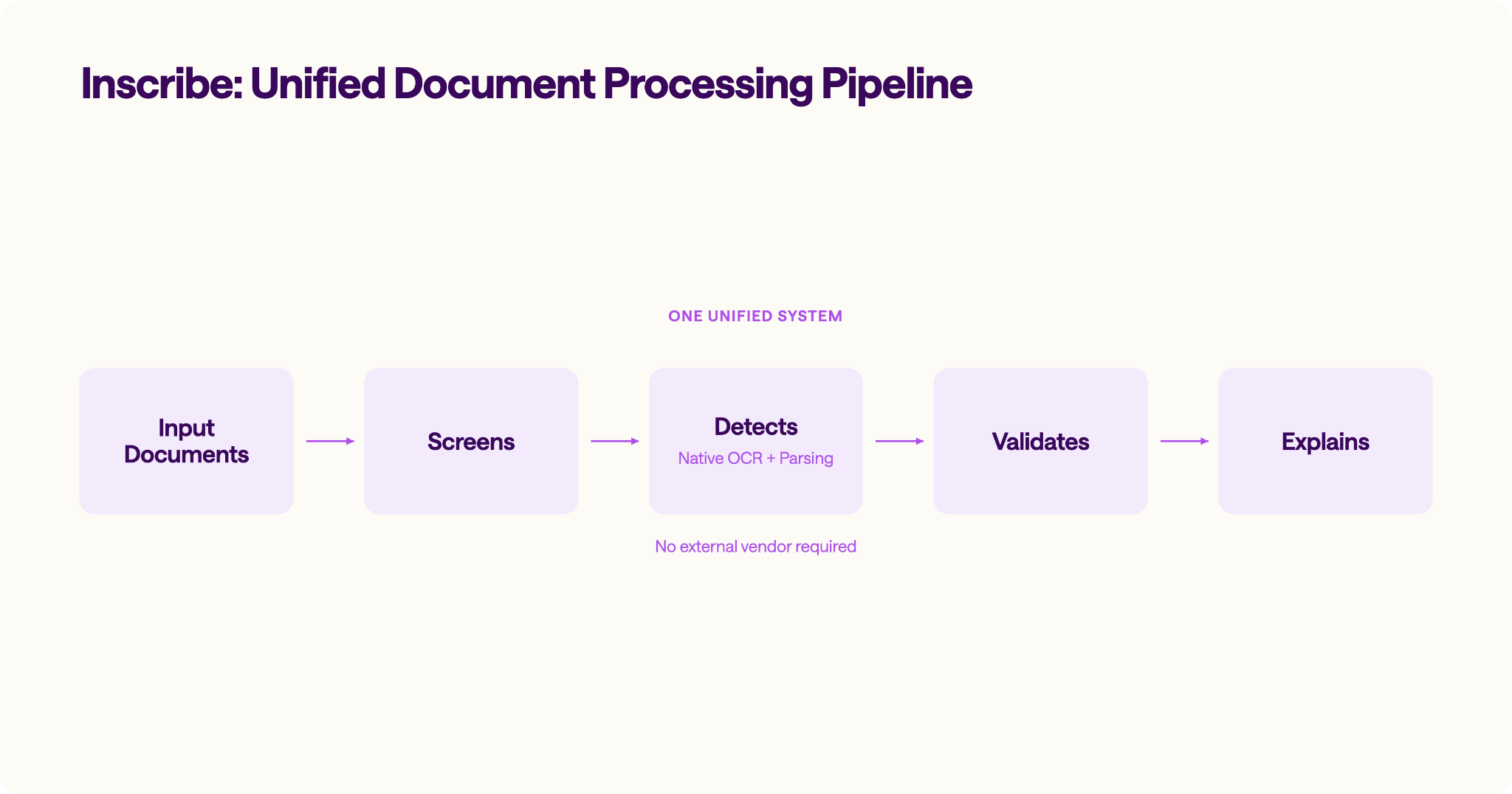
Inscribe is built for teams that want document fraud detection, processing, parsing, and applicant level context in a single workflow. That makes it especially relevant for U.S.-focused lenders, fintechs, credit unions, and banks reviewing bank statements, pay stubs, tax documents, invoices, utility bills, and other financial documents.
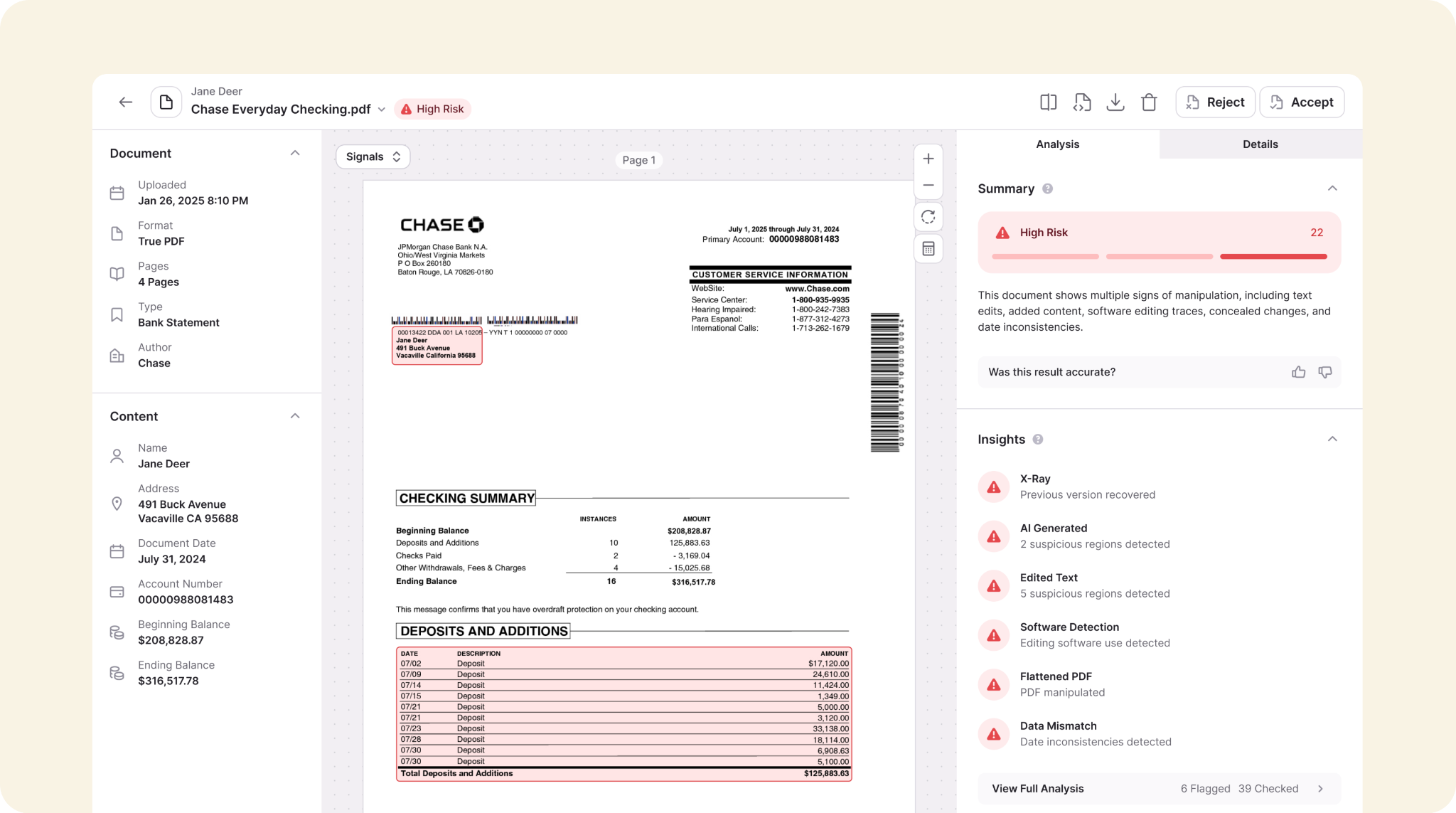
Inscribe uses AI Agents and LLM powered detectors to analyze documents across multiple verification layers (formatting, structure, metadata, image forensics, data consistency, and cross-document context) and surface findings in relation to each other. Rather than presenting a list of individual document signals, the system contextualizes findings against other evidence in the same application: mismatched income, inconsistent employer data, or unusual deposit behavior.
Inscribe also provides native parsing, which removes a vendor dependency for teams that need to extract fields from financial documents in addition to verifying document authenticity. Many fraud cases aren't visible from metadata alone. A document can look clean but still contain manipulated income, altered balances, or mismatched data across submissions.
For example, a reviewer may receive an application with:
- A pay stub showing high income
- Bank statements showing deposits that don't match the pay schedule
- A tax return with a different employer name
- A utility bill with an inconsistent address
Cross-document reasoning across all four catches patterns that per-document checks would miss individually.
According to Inscribe's 2026 Document Fraud Report and published customer case studies, Inscribe has reported the following outcomes across its network:
These figures come from Inscribe's own reporting. Prospective buyers should validate performance on their own document sets during evaluation.
- Logix Federal Credit Union: prevented over $3 million in fraud over eight months
- BCU: prevented $5.6 million in fraud over nine months
- Document review time: reduced from roughly 10–15 minutes per document to approximately 72 seconds
- AI-generated document fraud: increased 5× across Inscribe's customer network from April to December 2025
- Fraud rate: approximately 1 in 16 documents (roughly 6%) showed signs of fraud across the Inscribe customer network
From an integration standpoint, Inscribe offers API access, a web app, secure document collection, and native integrations with Alloy, Tactile, and MeridianLink (incoming). Inscribe prices per document with volume discounts, which offers more cost predictability as teams scale and avoids per-seat pricing that can increase costs for larger teams.
The main fit consideration for Inscribe is geography. Public examples strongly emphasize U.S. financial documents and U.S.-style underwriting workflows including W-2s and 1099s. Teams with significant EU document volume or region-specific compliance requirements should evaluate coverage before committing, as Resistant AI holds a clearer advantage in those markets.
Inscribe is strongest when:
- The team reviews high volumes of U.S. financial documents
- Native OCR, parsing, and data extraction are core requirements
- Applicant-level context matters more than per-document forensic depth
- The team wants fewer vendor dependencies
- Pricing predictability at scale is important
It may require more evaluation when:
- The organization has heavy EU or non-U.S. document volume
- The team requires very stable, slow-changing workflows with minimal product updates
- Granular per-document forensic evidence is the primary requirement
What Does Platform Choice Mean for Review Costs?
The cost of choosing a fraud detection platform extends beyond the software contract. It includes review time, missed fraud, vendor sprawl, integration lift, training, compliance overhead, and the operational burden of false positives.
Manual review is one of the clearest cost drivers. Inscribe reports that manual document review typically takes 10–15 minutes per document, while its system reduces that to approximately 72 seconds. For a team reviewing 200 documents per day, the difference is significant:
- Manual: 200 documents × 12 minutes = 2,400 minutes (40 hours of review per day)
- Inscribe: 200 documents × 72 seconds = 240 minutes (4 hours of review per day)
- Estimated time saved: approximately 36 hours per day under ideal conditions, equivalent to more than four full 8-hour workdays.
Comparable time savings benchmarks from Resistant AI are not publicly available, so buyers evaluating both platforms should request data specific to their document volumes and workflows during vendor conversations.
Vendor sprawl is a separate consideration. Teams that choose a platform focused on document authenticity but not native parsing may need additional vendors for OCR, data extraction, income verification, and underwriting decisioning. Some organizations prefer best-in-class components at each layer; others prefer fewer vendors and a more unified workflow. Both approaches are legitimate depending on the existing stack and integration capacity.
Missed fraud remains the largest cost factor regardless of platform. Document fraud resulted in over $10 billion in losses in North America in recent years, primarily due to identity theft and counterfeit documents. According to the FTC, there were over 1.1 million cases of identity theft in the U.S. in 2023, with document fraud as the largest contributing factor.
Whistleblower tips account for over 40% of initial fraud discoveries, which means reporting systems and trained staff remain important alongside any automated detection platform. Regular audits and up-to-date fraud pattern monitoring are also essential, particularly as generative AI continues to lower the cost of producing realistic fake documents.
Side-by-Side Comparison: Inscribe vs. Resistant AI
The table below compares both platforms across key evaluation criteria based on publicly available positioning and documented capabilities.
Which Document Fraud Detection Platform Should You Choose?
The right platform depends on team size, geographic focus, existing stack, analyst workflow, and operational priorities.
Resistant AI is the stronger fit for teams with significant EU exposure, a broad international document mix, or a primary need for granular, per-document forensic analysis. Teams that already have OCR and parsing tools in place and want to add a dedicated document authenticity layer will find Resistant AI's depth valuable.
Inscribe AI is the stronger fit for U.S.-focused lenders, fintechs, credit unions, and financial institutions that want fraud detection, document parsing, and applicant-level context in one workflow. Teams that want to reduce vendor dependencies and bring document processing and fraud detection under a single platform will find Inscribe's unified approach a better operational match.
For teams still evaluating, the clearest step is to test both platforms on your own document set, including clean documents, known fraudulent documents, scanned submissions, AI-generated examples, bank statements, tax returns, identity documents, and edge cases from your actual workflows. Measure detection performance, reviewer time, false positive rate, integration effort, and how clearly each system supports your compliance decisions.
Both platforms offer evaluation paths. If Inscribe looks like a fit for your team, request a demo here. For Resistant AI, visit their site to explore their evaluation process.
Frequently Asked Questions

Inscribe is a unified platform combining fraud detection, document parsing, and applicant-level context in one workflow, built primarily for U.S. focused lenders. Resistant AI specializes in deep, per-document forensic analysis with particularly strong coverage for European financial institutions.
Inscribe is the stronger fit. It's built around U.S. financial document types like bank statements, W-2s, 1099s, and pay stubs, and includes native OCR and parsing so teams don't need a separate extraction vendor.
Resistant AI. It's positioned as language- and document-agnostic with strong forensic coverage across the varied document formats, languages, and regulatory requirements common in EU markets.
Both. Inscribe natively parses and extracts data from financial documents in addition to verifying authenticity, so teams don't need a separate parsing vendor layered on top.
Resistant AI's public positioning focuses on document authenticity, metadata analysis, and anomaly detection. Teams that also need full native extraction of fields, balances, or transactions should confirm this directly with Resistant AI before committing.
Inscribe is designed for cross-document reasoning, flagging inconsistencies across a full application (e.g., a pay stub and bank statements that don't align). Resistant AI focuses on per-document forensic depth rather than holistic applicant-level profiles.
Inscribe prices per document with volume discounts and offers unlimited user access. This makes costs more predictable as teams scale compared to per-seat pricing models.
Pricing isn't publicly disclosed. Buyers should confirm directly whether it's per-seat, usage-based, flat, or hybrid, and model costs at their expected document volume before committing.
Inscribe reports reducing document review time from roughly 10 to 15 minutes per document down to approximately 72 seconds. For a team reviewing 200 documents a day, that's an estimated 36 hours saved daily.
Run both platforms on your actual document set, including clean documents, known fraudulent ones, AI-generated examples, scanned submissions, and edge cases from your real workflows. Measure detection accuracy, false positive rate, reviewer time, and integration effort.
You can request a demo directly through Inscribe's website.
About the author
Brianna Valleskey is a B2B marketing leader and Head of Marketing at Inscribe, where she leads the company's full marketing function and go-to-market strategy. She oversees brand, product marketing, demand generation, ABM, content, SEO/AEO, events, partnerships, and marketing operations, with responsibility for marketing pipeline and SQO targets. A former journalist and longtime storyteller, Brianna specializes in translating complex AI, fraud, identity, and fintech topics into clear narratives for enterprise audiences. She is the creator and host of Good Question, Inscribe's podcast on AI and fraud risk, and leads Inscribe's annual State of Document Fraud report.
Learn More
Dive deeper into document fraud

What will our AI Agents find in your documents?
Start your free trial to catch more fraud, faster.