
AI agents for credit risk and underwriting
Table of Contents
[ show ]- Loading table of contents...


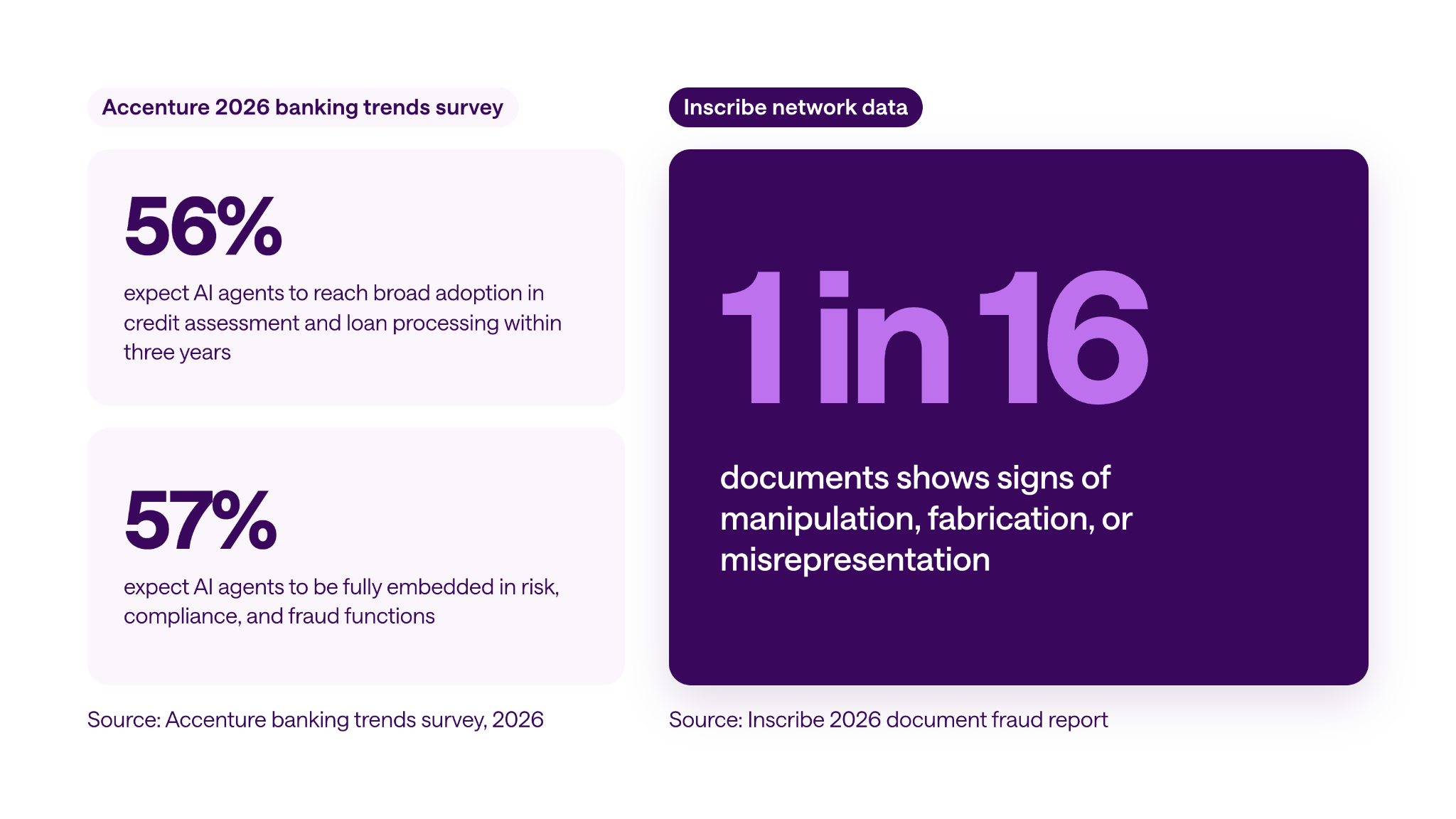
Banks and other financial institutions expect AI agents to move quickly into credit risk and underwriting. In Accenture’s banking trends survey for 2026, more than half of banking executives (56%) said they expect AI agents to reach broad adoption in credit assessment and loan processing within three years, and 57% expect them to be fully embedded in risk, compliance, and fraud functions.
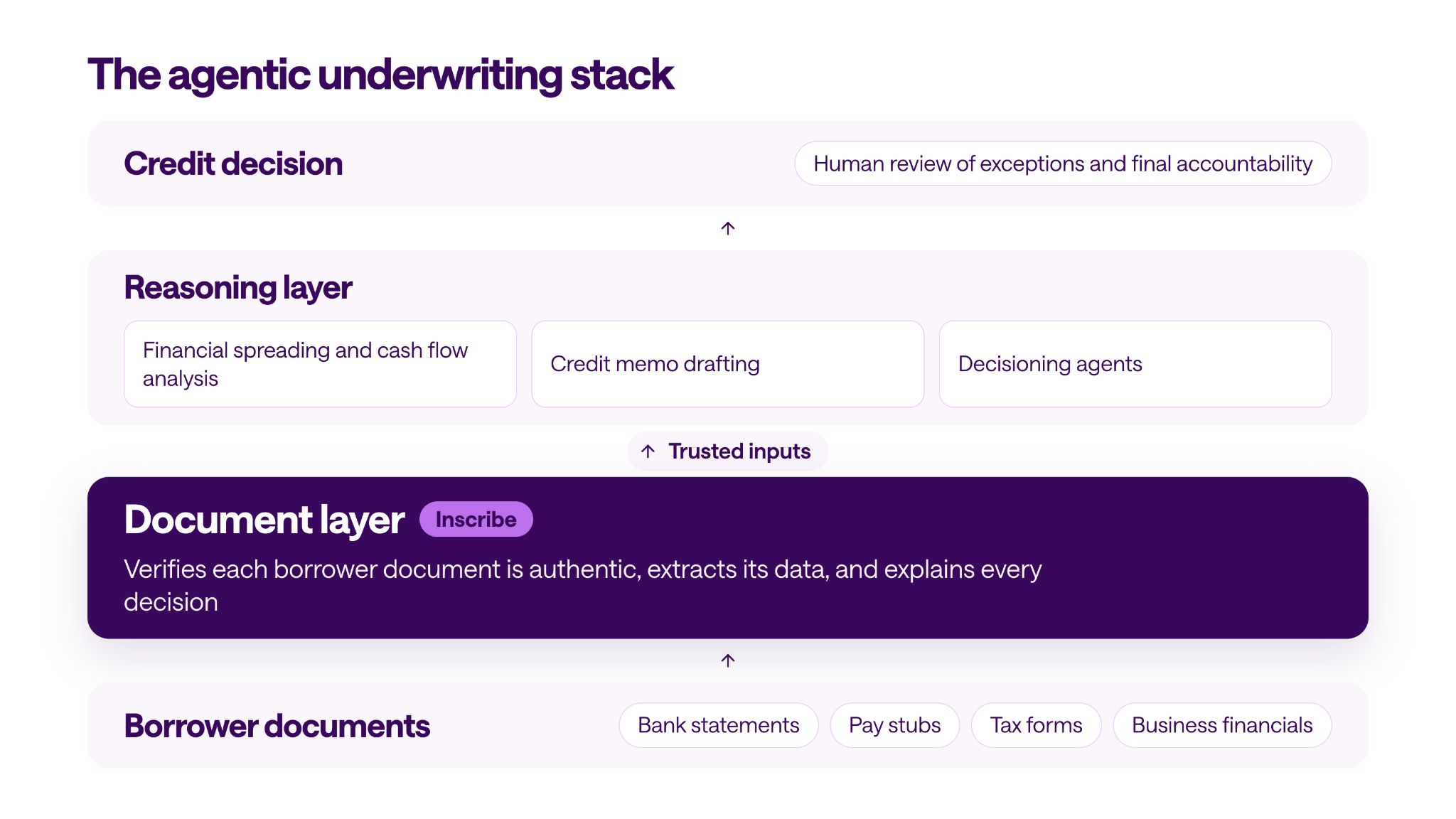
Some of the most visible use cases sit in the reasoning layer with agents that spread financials, draft credit memos, and orchestrate decisioning. But every credit decision is built on borrower-supplied data, and across Inscribe’s network roughly 1 in 16 documents shows signs of manipulation, fabrication, or misrepresentation. An agent that spreads a fabricated bank statement can still return a well-formatted wrong answer, and speed only compounds the exposure.
That is why the document layer matters, and why it belongs inside AI fraud detection for lenders.
Inscribe is the document layer for AI agents in credit risk and underwriting: agentic document fraud detection that verifies each borrower document is authentic, extracts its data, and explains every decision before your credit models trust a single number.
Purpose-built for document risk screening since 2017, SOC 2 Type II and ISO 27001 certified, and trusted by leading banks, credit unions, and fintechs, Inscribe returns results in about 72 seconds per document on average across its network. See the agents work end to end in the Demo Center.
What are AI agents for credit risk and underwriting?
AI agents for credit risk and underwriting are AI systems, often built around large language models, that plan and carry out multi-step lending tasks. They gather borrower data, verify it, analyze it against credit policy, and draft the outputs an underwriter or credit committee needs, with people reviewing exceptions and remaining accountable for the final decision. They differ from the scoring models and rules engines lenders have run for decades in one important way. A credit model takes structured inputs and returns a probability, and a rules engine applies the conditions someone already wrote down. An agent decides what to examine next, calls the tools it needs, and explains what it did. Most run on generative AI: an LLM reasons over the loan application, often with retrieval-augmented generation grounding it in your credit policy and required-document checklist, and routes edge cases to human judgment.
That difference makes agents a natural fit for the document-heavy, judgment-heavy work between application and decision. McKinsey’s analysis of a retail bank’s credit memo workflow found relationship managers spending weeks assembling memos from more than ten data sources. A multiagent proof of concept that extracted data, drafted memo sections, and generated confidence scores showed a potential 20 to 60 percent productivity gain and a 30 percent improvement in credit turnaround, with the analyst’s role shifting to oversight and exception handling. The capacity gain comes from automation of the assembly work, with underwriters free to focus on the decision.
Inscribe’s AI fraud agents are one specialized component of that agentic underwriting stack. Their role is narrow but foundational, establishing whether each document in the file can be trusted and explaining why. Our companion page on agentic AI fraud detection covers the detection method in depth. This page covers where that work fits in credit risk assessment.
How are AI agents being applied to credit risk assessment and underwriting workflows?
AI agents are being applied across the lending lifecycle, from loan applications through portfolio monitoring. They handle repeatable, multi-step work while underwriters retain judgment and accountability, and the gains show up as shorter cycle time, more consistent outcomes, and lower cost per file. Common workflows include:
- Application intake and document collection. Agents request the required documents for the loan type, follow up on missing items, and pre-screen files for completeness the moment they arrive. Inscribe’s secure document collection portal runs fraud review at that same point, so a suspicious or incomplete file can be caught at upload rather than days later in a queue.
- Document verification and data extraction. Before a number reaches a spreadsheet, an agent confirms the document is authentic and pulls its fields. This is Inscribe’s core work. It applies layered network, forensic, semantic, and perceptual detection to every bank statement, pay stub, tax form, and business financial, with extraction paired to the same review so downstream systems receive the data with trust context attached. Document verification for lenders covers the document types in depth.
- Financial spreading and cash flow analysis. Agents parse transactions, reconcile balances, and calculate the income and cash flow metrics a credit policy depends on, and surface the risk factors an underwriter should weigh. Inscribe’s Bank Statement Analyzer adds transaction categorization and flags NSFs, overdrafts, and irregular deposits.
- Business and applicant due diligence. For commercial and small business lending, agents verify incorporation status against Secretary of State records, confirm web presence, and check adverse media, the KYB research an analyst used to run by hand across several systems.
- Credit memo drafting and decision support. Agents assemble the narrative, compute ratios against policy, and surface the exceptions a committee should discuss. This is the workflow McKinsey studied above, and one of the clearest examples of what teams mean by “agentic underwriting.”
- Fraud pattern detection across applications. The same signals that flag one fabricated statement can expose a recycled template across dozens of applications. Inscribe’s network detection compares every submission against a library of genuine and fraudulent documents, so fraud rings surface while the applications are still open and detection becomes fraud prevention.
Several of these workflows begin with the same question. Can the borrower document be trusted?
Where does fraud risk fit in the broader underwriting risk assessment?
Document fraud risk sits at the front of the underwriting risk picture, before credit analysis begins, because credit risk assessment and fraud screening often depend on the same borrower inputs. A credit model asks whether this borrower, with this income and these balances, is likely to repay. If those inputs were edited before submission, downstream reasoning can be precise and still be wrong.
The 2026 Document Fraud Report shows how often that happens. Among altered documents, 91.2% include edits to financial details such as pay rates, deposits, balances, and wages. The share of flagged documents with both identity and financial edits rose from 40.2% in 2024 to 59.8% in 2025. The documents underwriters rely on most are also the ones fraud leaders consider most vulnerable. Of the 90 risk leaders surveyed, 85.6% named bank statements as their top concern, followed by pay stubs and business financials.
First-party fraud is especially tricky in underwriting because the applicant is real, even when the documents are not fully trustworthy. Someone may alter a genuine pay stub or bank statement to qualify for a loan. Identity checks can still come back clean, and a credit model can end up treating those edited figures as legitimate.
That is why lenders need to know the documents are authentic before extracted data moves downstream. Inscribe’s agents do that work upfront, then pass verified data into the next step, whether that is a decisioning agent, a loan origination workflow, or an underwriter’s queue. The rest of the fraud stack, including identity verification and transaction monitoring, continues to run alongside it. Inscribe’s role is to make sure the credit decision starts with inputs that can be trusted, at whatever scale demand requires.
How do Inscribe’s AI agents support faster decisions inside an underwriting workflow?
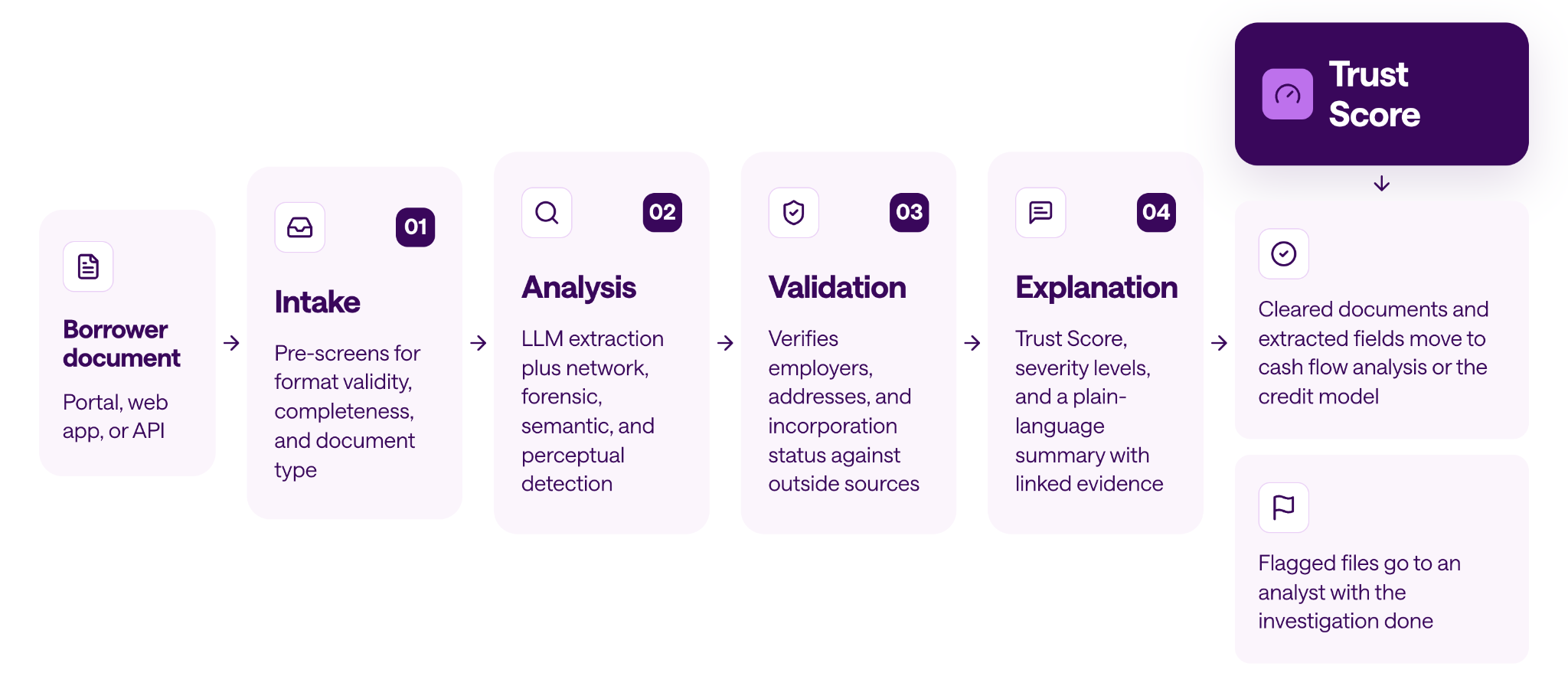
Inscribe’s AI agents review each borrower document the moment it enters the underwriting workflow and return a document trust decision your underwriters can act on, moving through four steps before anyone on your team needs to look:
- Intake. The document enters through your portal, web app, or API, and the agent pre-screens it for format validity, completeness, and type accuracy, so incomplete or mislabeled files are routed back before they slow the queue.
- Analysis. LLMs extract key fields and evaluate formatting, logic, and consistency, while network, forensic, semantic, and perceptual detectors search the document for recycled templates, metadata tampering, cross-document contradictions, and pixel-level edits.
- Validation. The agent can also look beyond the document itself by verifying employers, cross-checking addresses, confirming incorporation status against Secretary of State records, and connecting outside sources to the claims in the file.
- Explanation. Findings are distilled into a Trust Score, severity levels that set the risk level of each signal, and a plain-language summary with linked evidence, so your underwriters see why a file cleared or why it did not. That risk scoring, with full traceability back to the evidence, is what makes the output usable in a decision.
The output feeds forward. Cleared documents and extracted fields move into cash flow analysis or the credit model, while flagged files reach an analyst with the investigation already done. That is where underwriting efficiency comes from: underwriters spend their time on judgment calls rather than page-by-page review, and the whole file moves faster. Inscribe deploys alongside your existing decisioning stack, with access through an API with webhook support, a web app, or the collection portal, and most teams are live within days. That is how banks, credit unions, and fintech lenders put the document layer at the front of origination without rebuilding what sits behind it, and without adding headcount to keep pace with growth.
If your generative AI agents already read documents, do you still need fraud detection?
Yes, because reading a document and establishing whether it can be trusted are different tasks, and many underwriting agents are built for the first. Extraction agents are optimized to pull fields accurately from whatever they are given, and their capabilities stop at reading. A fabricated pay stub from a template site, or a real statement with an AI-edited balance, can still look perfectly usable to an extraction system. The totals may reconcile, the formatting may look right, and the edited figure can move downstream without showing that the source was manipulated. In 2025, 1 in 5 flagged documents across Inscribe’s network showed signs of template-based manipulation, up from 1 in 14 in 2024, and the detected volume of AI-generated document fraud grew nearly fivefold between April and December 2025.
Catching those files requires looking at signals that extraction systems typically do not evaluate. That can include metadata and file history, template lineage across Inscribe’s network, contradictions between documents in the same file, and pixel-level artifacts. Inscribe’s document fraud detection software runs that layered analysis on every document, and because the agents are trained on millions of authentic financial documents and tested against the latest fraud tactics, they can flag novel fakes instead of waiting for them to become known patterns.
For lenders already underwriting with AI, that is the difference between underwriting intelligence and document trust. One reasons over the data, while the other determines whether that data can be trusted in the first place.
What does the document layer change for underwriting efficiency and decision making?
The clearest results Inscribe can prove today are at the document layer: less manual review, faster decisions, and fewer fraudulent files making it into downstream decisioning. Underwriter capacity is the first thing to change. Before automated verification, some institutions in the 2026 Document Fraud Report said they were spending 60 to 90 minutes per application on document review alone, an expense that grows with every loan application.
“Before Inscribe, thousands of documents a day were reviewed by a human pair of eyes. I have memories of us being super busy some nights and staying up until midnight just trying to get through the documents manually.” Timothy O’Rear, Senior Underwriter at Rapid Finance
The pattern holds across Inscribe’s lending customers, from credit unions to national fintech operations.
- Kinecta Federal Credit Union prevented $850K in losses while cutting review time by 99%.
- Logix Federal Credit Union saved more than $3M in potential fraud losses in eight months.
- Michael Coomer at BHG Financial reports a 90% reduction in document review time after replacing manual fraud detection with a transparent, scalable system.
- Plaid cut document review in its income verification products from 1-2 days to seconds and automated half of its reviews, so the lenders on its platform get cleared documents back in real time, while the applicant is still in the flow, and can respond faster than a lender still waiting on manual review.

What governance and audit trails do AI agents need in credit underwriting?
AI agents in credit underwriting need defined ownership, human oversight of exceptions, documented reasoning, and audit trails an examiner can test. The regulatory compliance picture is evolving, but three current points matter for financial institutions putting agents into production:
- Federal guidance changed, while adverse-action obligations remain. The CFPB withdrew its AI adverse-action circulars as part of a bulk withdrawal of 67 guidance documents effective May 12, 2025. The underlying legal obligation did not change. Under ECOA and Regulation B, a creditor that takes adverse action must still provide specific principal reasons, regardless of the technology used.
- Revised model risk guidance treats agentic AI separately. In April 2026, the OCC, Federal Reserve, and FDIC issued revised model risk management guidance that supersedes SR 11-7. The guidance explicitly excludes generative and agentic AI models from its scope because they are novel and rapidly evolving, while stating that banks’ broader risk-management and governance practices should determine appropriate controls for tools outside its scope. That makes institution-level governance and vendor documentation especially important.
- Colorado adds state-level requirements for covered automated decision-making. Colorado’s rewritten AI law, SB 26-189, passed in May 2026 and takes effect January 1, 2027. It covers automated decision-making technology that materially influences lending decisions and includes consumer notice, post-adverse-outcome explanations, data-correction rights, and meaningful human review, subject to specified exemptions.
The practical implication for lenders deploying agents is to preserve human accountability and a reviewable record of what the system found and why. At the document layer, that means every flag needs supporting reasoning and a consistent audit trail. Inscribe’s agents return a plain-language explanation of what was detected, the severity of each signal, and linked evidence, giving teams documentation they can use in exams, audits, and fair lending reviews, and giving underwriters the context to make better decisions. Detection improves over time as the agents learn from analysts’ in-app reviews and ongoing training by Inscribe’s in-house Risk Ops team, and the platform is SOC 2 Type II and ISO 27001 certified.
Next steps: see AI agents on your own underwriting documents
Inscribe is the document layer for AI agents in credit risk and underwriting. It’s agentic document fraud detection that verifies each borrower document is authentic, extracts its data, and explains every decision before your credit models trust a single number. The fastest way to evaluate it is with the documents your underwriters review today.
👉 Read the full guide to AI fraud detection for lenders
👉 Explore the loan underwriting hub
👉 See what your underwriters are up against in the 2026 Document Fraud Report
👉 Explore the Demo Center
Frequently asked questions about AI agents for credit risk and underwriting

AI agents for credit risk and underwriting are AI systems, often built around LLMs, that plan and carry out multi-step lending tasks, from collecting and verifying borrower documents to spreading financials and drafting credit memos, with underwriters reviewing exceptions and remaining accountable for the decision. Inscribe is the document layer in that stack that verifies each borrower document is authentic, extracts its data, and explains every decision before your credit models trust a single number.
A credit scoring model takes structured inputs and returns a probability. An AI agent decides what to examine, calls the tools it needs (extraction, external databases, other models), adapts to what it finds, and explains its reasoning. That makes the document-heavy work before the score is calculated a natural place to use agents, which is where Inscribe operates.
Common starting points include document collection, document verification and extraction, financial spreading, KYB due diligence, and credit memo drafting. McKinsey’s study of a retail bank’s credit memo workflow found a potential 20 to 60 percent productivity gain, and Inscribe customers report review time reductions of 90% or more at the document layer.
At the front. Credit analysis and fraud screening often depend on the same borrower documents, and 91.2% of altered documents include edits to financial details. Inscribe verifies each document before its data reaches spreading, cash flow analysis, or the credit model, so downstream agents work from trusted inputs.
Inscribe connects through an API with webhook support, a web app, or a secure document collection portal, and returns a Trust Score, severity levels, extracted data, and an explanation for each document. Verified data flows to your existing LOS, decisioning platform, or credit agents; flagged files route to an analyst with the investigation already done. Most teams are live within days.
Yes. First-party fraud, where a real applicant alters real documents to qualify, can pass identity checks and may also pass credit models if the edited figures look legitimate. Inscribe’s agents catch it at the document level through forensic signs of editing, semantic contradictions across the file, and network matches against known templates, then explain what changed so your team can act on it.
Explainable outputs, documented reasoning, audit trails, human oversight of exceptions, security controls, and a governance program that covers agents directly. The revised interagency model risk guidance of April 2026 excludes generative and agentic AI from its scope and points banks back to broader risk-management and governance practices for those systems. Inscribe supports that operational need with plain-language explanations and linked evidence on every document decision, SOC 2 Type II and ISO 27001 certification, and agents that learn from analysts’ reviews under your governance.
Bank statements, pay stubs, tax forms, business financial documents, invoices, utility bills, and identity documents, among others. They are the files underwriting depends on, including the document types risk leaders flagged as most vulnerable in the 2026 Document Fraud Report. Each is verified, extracted, and explained by the same agentic document fraud detection that makes Inscribe the document layer for AI agents in credit risk and underwriting.
Close to it. Inscribe’s agents return a document trust decision in about 72 seconds per document on average across its network, with the Trust Score, risk level, and explanation attached, so a lender can clear or route a file while the applicant is still in the application flow. The credit decision itself stays with your team and your credit policy.
Most teams are live within days. Inscribe connects through an API, a web app, or a secure document collection portal, so the agents start reviewing documents inside your existing underwriting workflow without a rebuild.
About the author
Conor Burke is the co-founder and CTO of Inscribe, where he leads the AI and engineering systems behind the platform's document fraud detection capabilities. He writes and speaks on the technical mechanics of fraud detection — how LLMs reason, where rules-based systems break down, and what it actually takes to build AI that explains itself.
Learn More
Dive deeper into document fraud

What will our AI Agents find in your documents?
Start your free trial to catch more fraud, faster.