
Document fraud detection for KYC workflows
Table of Contents
[ show ]- Loading table of contents...


KYC identity verification confirms a person is who they claim to be. Document fraud detection is the complementary layer that checks whether submitted identity and financial documents are genuine by analyzing tampering, forgery, AI generation, metadata, pixel-level edits, and consistency across documents. Forged IDs, manipulated proof-of-address files, and AI-generated pay stubs regularly pass standard identity checks from providers like Jumio, Onfido, Persona, Sumsub, and Trulioo.
For risk, fraud, compliance, and underwriting teams at banks, credit unions, fintechs, lenders, and other organizations that rely on KYC workflows, this gap creates direct fraud exposure and unnecessary manual review.
In 2025, Inscribe found that 1 in 16 financial documents submitted across banks, credit unions, lenders, and fintechs showed signs of manipulation. AI-generated document fraud has grown roughly 4x over the eleven months from June 2025 to May 2026, hitting a new all-time high in May.
This article explains where identity verification stops and document authenticity begins, which documents are typically verified across KYC flows, from IDs and proof of address to income documents, how document fraud detection fits alongside identity providers, and the forensic methods and proof points teams use to catch fake documents before they reach onboarding, underwriting, or ongoing risk decisions.
Where do KYC identity checks stop and document risk begin?
KYC providers like Jumio, Onfido, Persona, Sumsub, and Trulioo verify the person: liveness checks, selfie-to-ID matching, sanctions and PEP screening, database lookups. They rarely inspect the submitted document file itself for tampering, AI generation, or document forgery in IDs and supporting files that standard checks may miss.
That gap matters. A real, verified person can still upload altered versions of legitimate documents to inflate income, fabricate an address, or hide risk, which can open fraudulent accounts, enable identity theft, and support other fraudulent activities. Bank statements and pay stubs are common targets, along with utility bills, tax forms, and government-issued IDs.
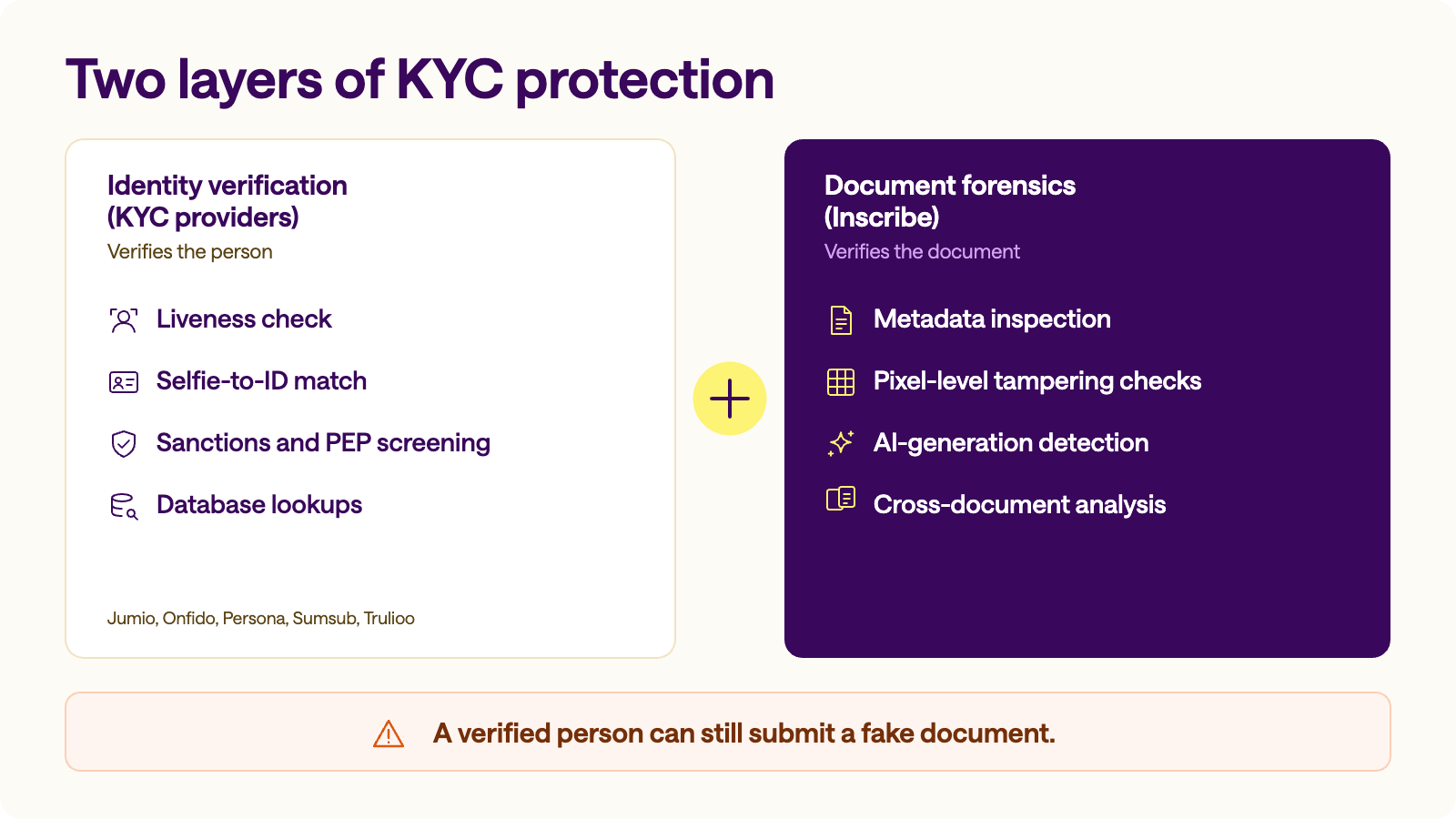
Inscribe adds a document forensics layer to existing KYC workflows, serving as a document verification solution that helps detect document fraud as part of broader fraud prevention in onboarding workflows.
What documents does Inscribe verify within KYC document verification workflows?
Most KYC processes collect more than a selfie and an ID. They also rely on supporting documents that are now common fraud targets:
- Identity documents such as driver's licenses and passports, where each document type may require different validation checks
- Proof of address documents including utility bills, bank letters, and lease agreements, frequently altered for proof of address fraud
- Income and employment documents such as pay stubs, tax forms, and bank statements used to qualify applicants during onboarding and help teams verify income
- Supporting documents adjacent to liveness checks, like secondary IDs and supplemental financial statements
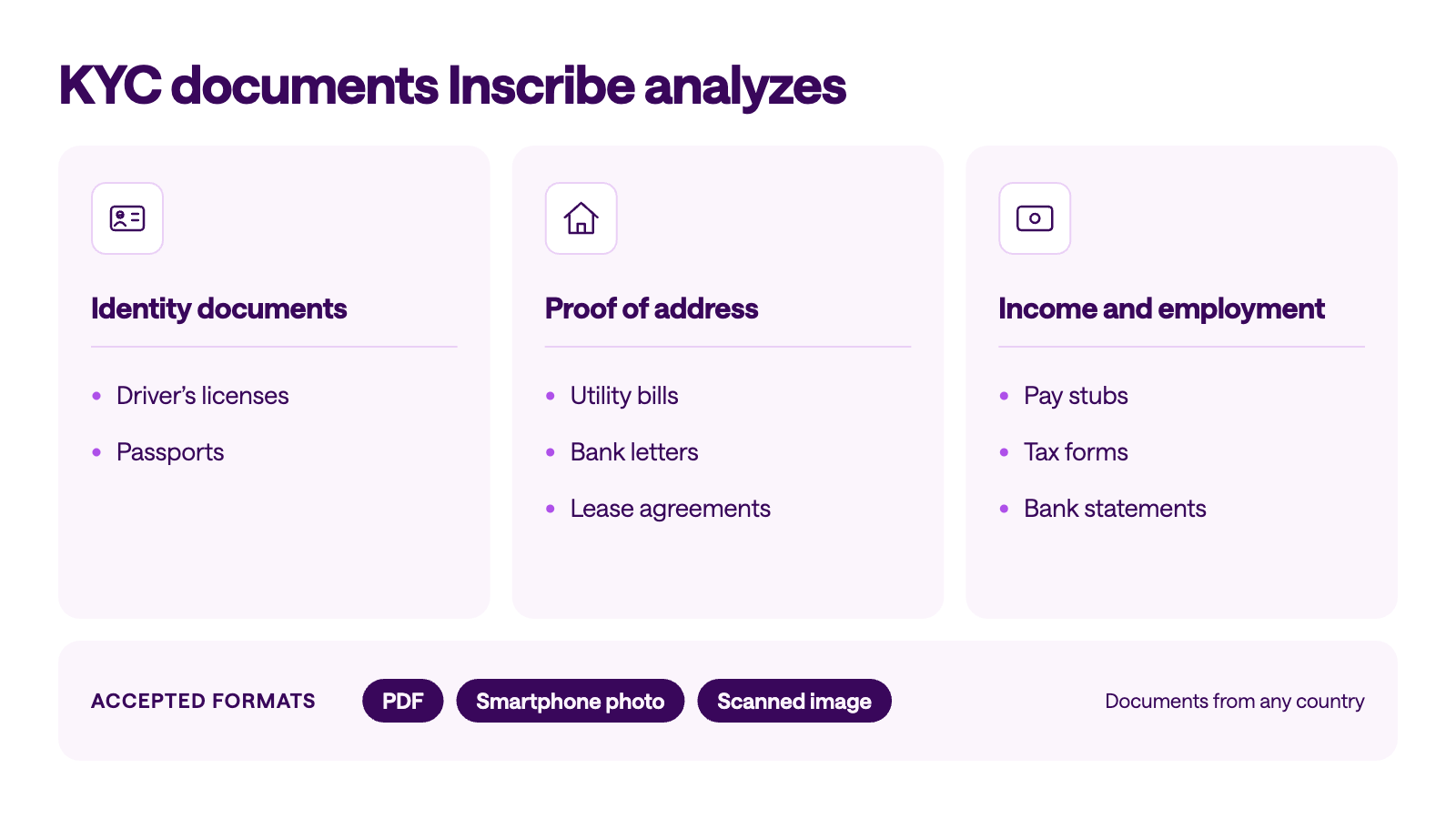
Inscribe's document fraud detection software can analyze documents across multiple document types by combining automated document authentication with OCR and computer vision, and it accepts PDFs, smartphone photos, and scanned images from any country for region-specific workflows such as lending and account opening.
How document forensics complements identity verification against AI- generated document fraud
Inscribe performs document fraud detection for KYC by integrating with identity verification platforms like Jumio, Onfido, Persona, Sumsub, and Trulioo rather than competing with them. It typically runs after a user submits ID and proof-of-address documents but before final approval, in parallel with identity checks.
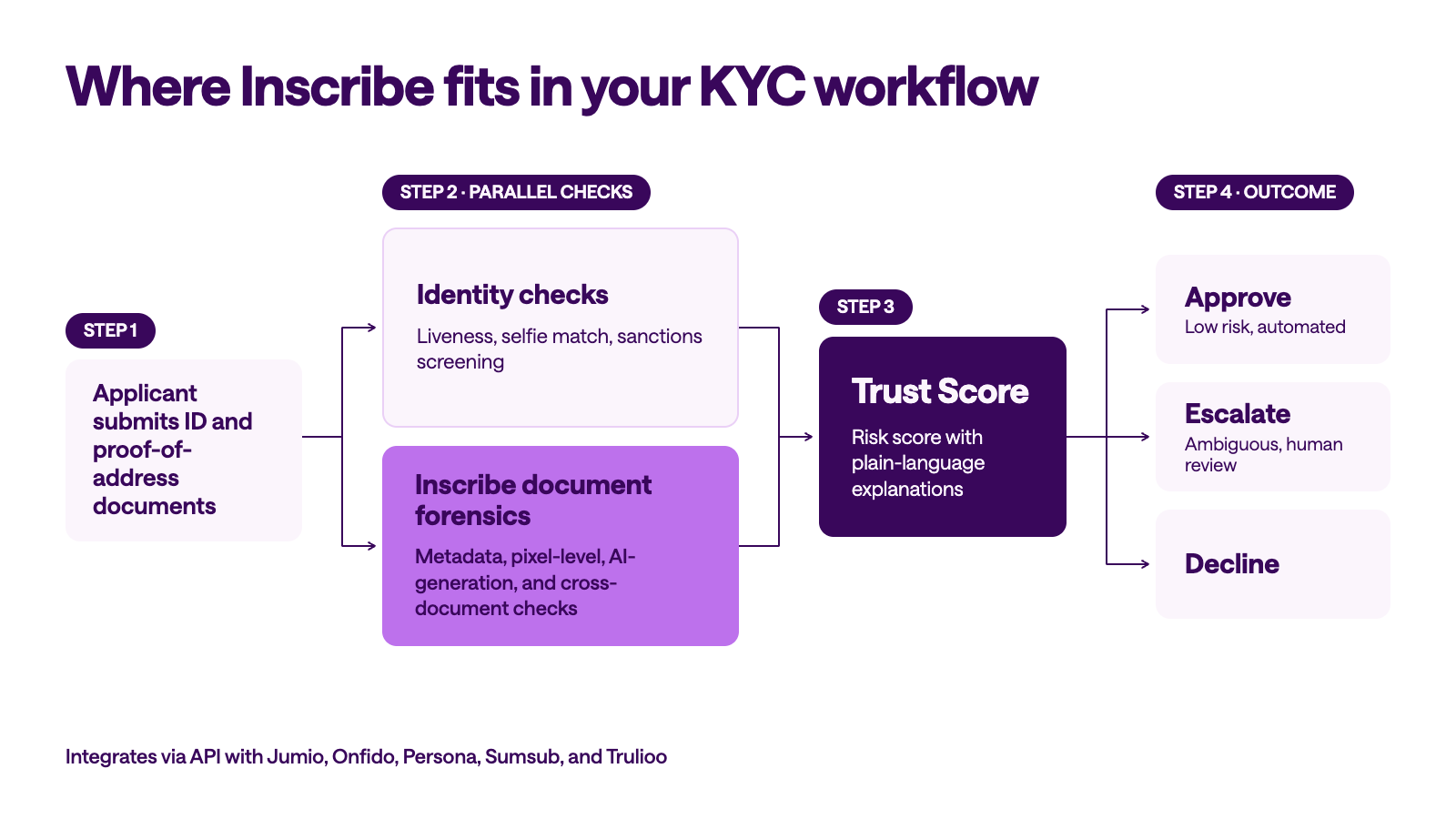
Core checks include metadata inspection of creation dates, edit history, document structure, security features, and the data contained in the file, plus pixel-level checks for tampering and AI-generated artifacts. AI-powered document fraud detection uses forensic analysis to surface fraud signals that manual review often misses and help detect altered invoices, AI-generated documents, and AI-generated document fraud; this also helps analyze documents against what genuine documents should look like for each document type within a document verification solution.
Cross-document analysis synthesizes patterns across multiple submissions to identify risks, while data cross-checking validates information against external sources and behavioral signals from the submission flow. Live document verification during upload adds another layer, alongside machine-learning checks for font and alignment anomalies and AI models that detect hidden inconsistencies in financial documents.
Every document gets a Trust Score, a single risk score and risk assessment output with plain-language explanations analysts can use to approve, escalate, or decline based on their risk appetite while keeping false positives in check.
Inscribe integrates via API, adding document-level fraud checks to identity, liveness, and sanctions screening already in place. For teams handling both individual and business verification, Inscribe also supports KYB document fraud detection.
This gives compliance teams and fraud teams configurable document checks within a framework for continuous compliance and broader fraud prevention, with automated decisions for low-risk files and human review for ambiguous cases instead of relying only on manual review or transaction monitoring.
Proof point: Amount
When Amount deployed Inscribe for account opening and KYC-related reviews, the results were measurable. "Inscribe was able to identify fraud on incredibly realistic documents. It's helped open our eyes to the new risks faced by our industry as fraudsters become even more sophisticated," said John Lynch, Senior Director of Fraud and Verification Services at Amount.
They saw a 23% increase in efficiency of document fraud detection, with 1,000+ documents uploaded and accurately analyzed for fraud in seconds. The gains came from reducing slow, error-prone manual review, lowering operational cost, limiting financial and fraud losses, and helping teams focus human review on the highest-risk files.
Closing
Identity verification alone can't confirm genuine documents or catch sophisticated document forgery, including AI-generated document fraud. Inscribe closes that gap in KYC workflows by reducing fraud attempts and strengthening fraud prevention for KYC teams. Request a demo to see how it works on your own documents.
FAQ: KYC document fraud detection

KYC traditionally focuses on identity verification and sanctions screening. Document fraud detection is a complementary layer that inspects the authenticity of the documents used in KYC: IDs, proof of address, and income documents.
By adding a document forensics layer that uses metadata inspection, document structure checks, security features, and forensic analysis alongside identity verification to detect document fraud. Inscribe runs AI-powered document fraud checks automatically, analyzes AI-generated documents and other fraud signals in seconds, and reduces reliance on manual review, with human review reserved for ambiguous cases. Stronger fraud prevention matters because, according to the Federal Trade Commission, fraud cost consumers more than $10 billion in 2023, and the LexisNexis True Cost of Fraud Study found that North American financial institutions spent $4.41 to combat each dollar lost to fraud that same year.
KYC verifies individuals and their personal documents. KYB verifies businesses and their corporate documents. See Inscribe's KYB document fraud detection page for the business side.
No. Inscribe integrates with KYC providers to analyze document authenticity, catching fraud that identity checks alone don't cover.
Government IDs and other identity documents, proof of address files, bank statements, pay stubs, and tax forms submitted during onboarding, including supporting financial documents used to verify income. Rising deepfake and AI-generated fraud makes continuous compliance and better risk assessment increasingly important.
About the author
Stephanie Spangler is the Head of Product Marketing at Inscribe, where she covers AI-powered fraud detection, document risk, and how financial institutions are adopting agentic AI. She writes on the intersection of product and practice — translating what fraud detection technology does into what it means for the risk teams using it.
Learn More
Dive deeper into document processing

What will our AI Agents find in your documents?
Start your free trial to catch more fraud, faster.